
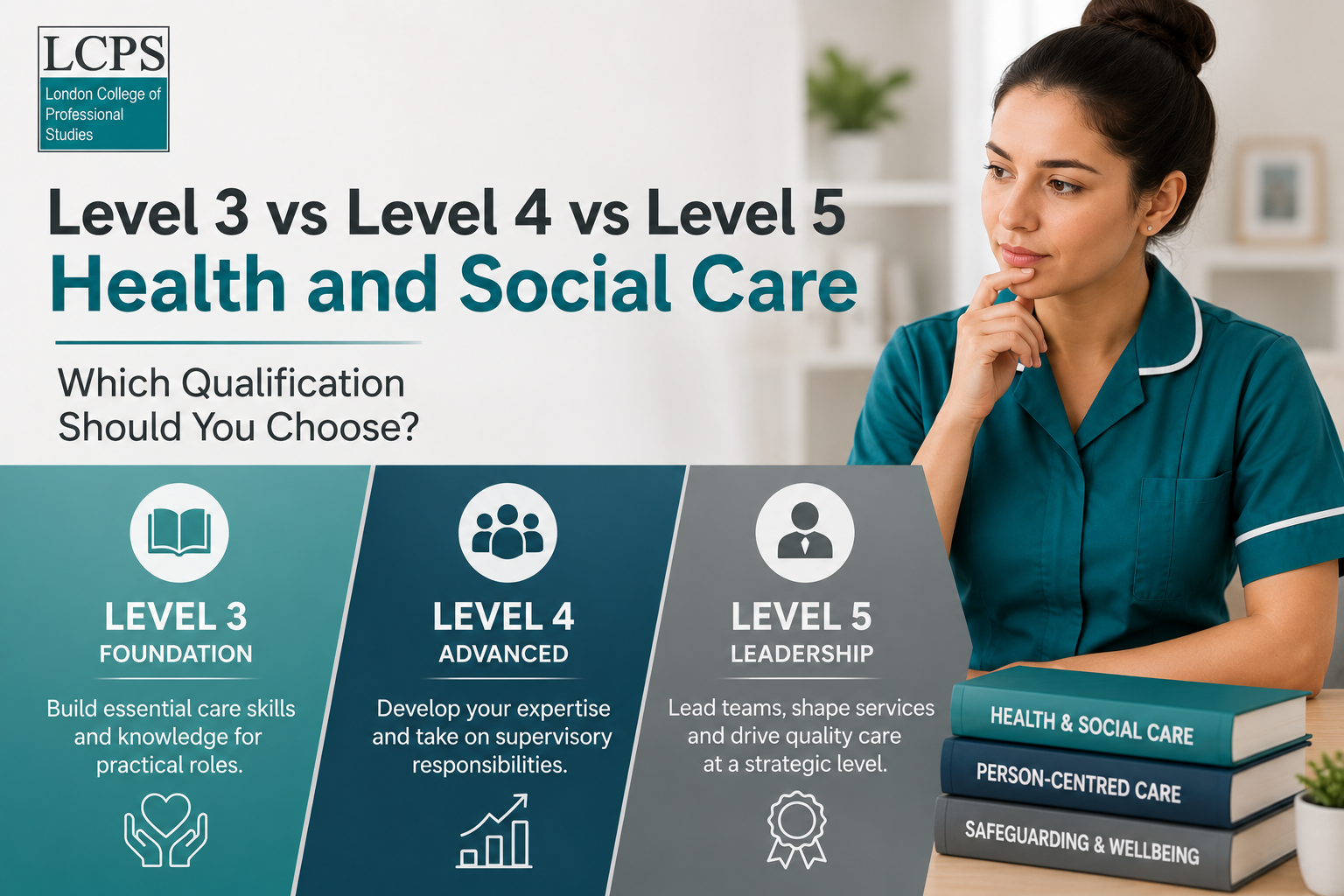
Which Qualification Should You Choose in Health and Social Care?
Choosing between Level 3 vs Level 4 vs Level 5 Health and Social Care qualifications is not simply a matter of picking the highest number. Each level is designed for a different stage of learning and professional responsibility, so the right choice depends on what you already know, the work you currently do and where you want to progress next.
Broadly, Level 3 develops the knowledge needed for effective care practice. Level 4 moves into more advanced practice, responsibility and elements of leadership. Level 5 has a much stronger focus on managing people, leading services and improving the quality of care.
That sounds straightforward, but there is an important detail: qualification titles and entry requirements can vary between awarding organisations. In adult social care in England, Skills for Care currently identifies qualifications including the Level 3 Diploma in Adult Care, Level 4 Diploma in Adult Care and Level 5 Diploma in Leading and Managing an Adult Care Service. Therefore, you should always check the exact qualification rather than judging a programme by its level alone.
The wider direction of the sector supports this idea of gradual development. The Department of Health and Social Care’s Care Workforce Pathway sets out the knowledge, skills, values and behaviours associated with different roles in adult social care. It connects learning with experience and career development rather than treating qualifications as isolated certificates.
So, which level should you choose? The answer becomes much clearer once you understand what actually changes from Level 3 to Level 4 and Level 5.
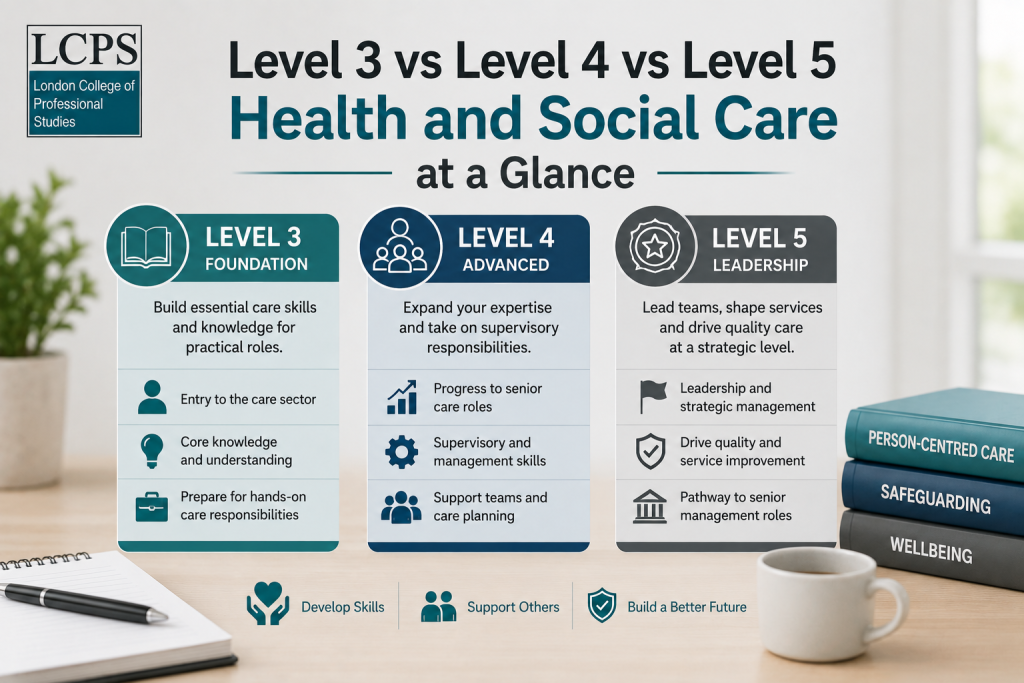
Level 3 vs Level 4 vs Level 5 Health and Social Care at a Glance
| Qualification Level | Typically Suits | Main Emphasis | Possible Direction |
|---|---|---|---|
| Level 3 | Care Workers, Support Workers and people developing professional care knowledge | Person-centred practice, safeguarding, communication and effective care | Senior Care Worker and roles with greater responsibility |
| Level 4 | Experienced practitioners, Senior Care Workers, Team Leaders and people moving towards supervision | Advanced practice, leadership development, decision-making and service improvement | Team Leader, Supervisor or advanced practice responsibilities |
| Level 5 | Experienced professionals, Team Leaders, Deputy Managers and aspiring managers | Leadership, management, governance, supervision and service improvement | Deputy Manager, Care Manager or Registered Manager pathway |
This table is a useful starting point, but it should not be treated as a guarantee of job progression. Employers consider experience, competence, communication, leadership and the requirements of the individual role alongside qualifications.
Understanding Health and Social Care Qualification Levels
Qualification levels indicate the difficulty and complexity of learning, but they do not tell you everything about a qualification. Two qualifications can sit at the same level while differing in size, content, assessment and purpose. For that reason, phrases such as “Level 5 is a degree” or “Level 4 automatically qualifies you as a supervisor” are too simplistic, for someone choosing a Health and Social Care course, it is better to think about the levels in terms of professional development:
Level 3: How do I provide good care and understand my professional responsibilities?
Level 4: How do I deepen my practice, take greater responsibility and begin supporting others?
Level 5: How do I lead people, manage services and contribute to quality, governance and continuous improvement?
This distinction matters because the best course is the one that fits the work you are ready to undertake.
What Is a Level 3 Health and Social Care Qualification?
A Level 3 Health and Social Care qualification is commonly chosen by people who want to develop a solid understanding of professional care practice. It can suit people already working as Care Workers or Support Workers, as well as those who need stronger formal knowledge before progressing towards greater responsibility. The emphasis is usually on understanding how safe, respectful and person-centred care should be delivered. Depending on the qualification, study may cover safeguarding, communication, equality, health and wellbeing, professional responsibilities and supporting people with different needs.
Level 3 is therefore more than an introduction to care tasks. It helps explain the reasoning behind good care practice.
For example, a Care Worker may already know how to support an individual with daily activities. Level 3 study can deepen that understanding by exploring why choice, dignity, communication, risk awareness and safeguarding matter when support is planned and delivered.
If you want a broader explanation of this level, read the LCPS Level 3 Health and Social Care guide.
Who Should Consider Level 3?
Level 3 may be appropriate if you are:
- working as a Care Worker or Support Worker;
- developing your professional knowledge of adult social care;
- seeking greater responsibility within your current role;
- preparing for progression towards senior care work;
- building a foundation before moving to higher-level study.
It can also be relevant to people who already have practical experience but want structured learning to support what they have learned at work. Skills for Care includes Level 3 qualifications within the adult social care qualification landscape and provides further guidance through its Adult Social Care Qualifications resources.
For professionals considering their next move after Level 3, our guide to qualifications for Senior Care Workers in the UK provides useful context.
What Is a Level 4 Health and Social Care Qualification?
Level 4 is where the nature of study begins to shift.
A professional at this stage may already understand frontline care well. The next question is often how to take on greater responsibility, support colleagues, exercise stronger professional judgement and contribute to improving the way a service operates.
A Level 4 Health and Social Care qualification can help bridge that gap.
Depending on the programme, learning may become more focused on advanced practice, leadership principles, decision-making, professional development and the operation of care services.
This makes Level 4 particularly relevant to experienced Care Workers, Senior Care Workers, Team Leaders and people beginning to undertake supervisory responsibilities.
How Is Level 4 Different From Level 3?
t is not a question of Level 3 being “basic” and Level 4 being “good.” The distinction lies in the level and kind of responsibility. For Level 3, the stress is still largely on care practice and the responsibilities of the profession.
For Level 4, the questions will be more like:
“How can practice be enhanced?”
“How can colleagues be assisted?”
“What if professional judgement is needed?”
“How can good decision making lead to better results?”
There is thus an inherent transition from practical expertise to management-oriented learning.
If you are currently considering this stage, LCPS has a separate guide examining whether Level 4 Health and Social Care is worth studying.
Who Should Consider Level 4?
Level 4 may suit someone who already has meaningful care-sector experience and is beginning to:
- support or guide colleagues;
- contribute to service improvement;
- make more complex workplace decisions;
- undertake supervisory responsibilities;
- prepare for further leadership study.
It is particularly useful when a person has moved beyond asking, “How do I perform my own role well?” and has started asking, “How can I help the wider team and service work well?”
That is an important change in professional perspective.
What Is a Level 5 Health and Social Care Qualification?
Level 5 represents a further shift towards leadership and management.
In adult social care, the Skills for Care qualification landscape includes the Level 5 Diploma in Leading and Managing an Adult Care Service, alongside other Level 5 qualifications with more specific purposes at this level, learning may cover broader responsibilities such as leadership, team management, professional supervision, governance, safeguarding, quality improvement, partnership working, resources and service development. The focus is no longer limited to being an excellent practitioner. Level 5 asks learners to consider what is required to help an entire team or service perform effectively. That distinction makes it particularly relevant for experienced professionals moving towards formal management responsibilities.
Who Should Consider Level 5?
Level 5 may be suitable for:
- Team Leaders
- Supervisors
- Deputy Managers
- experienced professionals already undertaking management responsibilities
- people preparing for progression into care-management roles
However, Level 5 should not be presented as a shortcut to becoming a manager.
Skills for Care’s guidance on the Level 5 leadership and management qualification stresses the importance of applying management knowledge and demonstrating competence in the workplace. For some competency-based Level 5 qualifications, learners need access to appropriate managerial duties so that their skills can actually be assessed.
If Level 5 is the stage you are considering, read Who Should Study a Level 5 Diploma in Health and Social Care? before making a decision.
You can also explore Level 5 Health and Social Care jobs and progression opportunities to understand where higher-level study may fit into a longer career plan.
Why Level 5 Is Particularly Relevant to Care Management
Being a manager in adult social care means more than just having a managerial job title.
Managers might find themselves leading teams, carrying out quality monitoring, undertaking safeguarding duties, facilitating compliance, managing resources and making decisions for both the staff and the people being cared for.
According to Skills for Care, the Level 5 leadership and management qualification has been created for managers working in adult social care services including Registered Managers.
Skills for Care also recommends the level 5 leadership and management studies to be done by those interested in advancing their career as Registered Managers, even though other factors are also significant.
This is why a Level 5 qualification can help someone develop a career path but does not guarantee one.
In case of planning a development into a Registered Manager or Care Manager, LCPS also has a detailed guide on how to become a Care Manager in the UK.
Level 3 vs Level 4 vs Level 5: What Really Changes?
Looking only at course titles can make the differences appear small. In practice, the biggest change is the perspective from which you are expected to think.
At Level 3: You Focus on Good Care Practice
The learner develops stronger understanding of how to support individuals safely and professionally.
Questions tend to centre on:
- How should I communicate?
- How do I safeguard someone?
- How do I support choice and independence?
- What are my professional responsibilities?
At Level 4: You Begin Looking Beyond Your Own Practice
The learner starts considering how practice can be developed and how other people can be supported.
Questions move towards:
- How can practice be improved?
- How should colleagues be supported?
- How can better decisions be made?
- How can I contribute to service quality?
At Level 5: You Think About Leadership and the Service as a Whole
The learner considers the responsibilities involved in leading others and managing care provision.
Questions become broader:
- How do I manage and develop a team?
- How do I maintain quality across a service?
- How should resources and responsibilities be managed?
- How can a service improve over time?
This progression in perspective is more useful than simply describing Level 3, Level 4 and Level 5 as low, middle and high.
Which Health and Social Care Qualification Should You Choose?
There is no single “best” qualification.
The best level is the one that makes sense for your current experience and intended next step.
Choose Level 3 if you are building your professional foundation
Level 3 may make sense when you are establishing your knowledge of care practice, working in direct support or preparing for greater responsibility.
Consider Level 4 if you already understand frontline care
Level 4 becomes more relevant when you are experienced enough to think beyond your own duties and begin contributing to supervision, decision-making or service improvement.
Consider Level 5 if leadership is becoming part of your role
Level 5 is more appropriate when your development is moving towards managing people, services and quality rather than concentrating mainly on direct care delivery.
Before enrolling, consider four questions:
What do I already know?
What responsibilities do I currently have?
What role do I want next?
Does the qualification’s entry and assessment model fit my situation?
Those questions are more useful than simply asking which level sounds most impressive.
Can You Progress From Level 3 to Level 5 Health and Social Care?
Yes. For many professionals, these qualifications form part of a wider development route rather than three unrelated choices.
An example pathway could look like this:
| Starting Position | Learning and Development | Possible Next Direction |
|---|---|---|
| Care Worker / Support Worker | Level 3 study and workplace development | Senior Care Worker |
| Senior Care Worker | Level 4 development and increasing responsibility | Team Leader / Supervisor |
| Team Leader | Level 5 leadership and management development | Deputy Manager |
| Deputy Manager | Management experience and continued Level 5 development | Registered Manager pathway |
This should be understood as an example, not a fixed formula.
The current Care Workforce Pathway for Adult Social Care reflects this broader principle. It identifies role categories including care or support worker, supervisor or leader, deputy manager and registered manager, helping the sector create clearer expectations around knowledge, skills, values and behaviours.
Progression still depends on the person. Qualifications matter, but so do workplace competence, communication, leadership, opportunities for development and the requirements of individual employers.
Do Employers Value Higher-Level Health and Social Care Qualifications?
Relevant qualifications can strengthen a professional profile because they demonstrate structured learning and a commitment to developing knowledge. But qualifications are only one part of the picture.
An employer recruiting for a senior care role may also want evidence that a candidate can:
- communicate well with colleagues and people receiving care;
- make sound decisions;
- apply safeguarding principles;
- lead or support a team;
- manage difficult situations;
- maintain quality standards;
- turn theoretical knowledge into effective practice.
This is particularly important at management level.
A Level 5 qualification may support a management application, but it does not replace the judgement, experience and competence needed to manage a real service.
Skills for Care provides wider workforce development resources for organisations and professionals developing capability within adult social care.
Is Level 5 Better Than Level 3 Health and Social Care?
No — not in the sense that one is universally superior.
Level 5 is higher in difficulty and complexity, but Level 3 and Level 5 serve different purposes.
For someone developing professional care practice, Level 3 may be exactly the right qualification and for someone already leading staff or preparing for service management, Level 5 may be more appropriate.
Choosing Level 5 simply because it is higher can create problems if the course assumes knowledge, experience or access to workplace responsibilities that you do not yet have.
The sensible question is therefore not:
“Which qualification is highest?”
It is:
“Which qualification fits what I need to learn next?”

Can You Start With Level 5 Without Completing Level 3?
Possibly, but it depends on the qualification.
There is no universal rule saying that every person must complete Level 3 and Level 4 before starting any Level 5 Health and Social Care programme.
An awarding organisation or education provider may consider factors such as:
- previous qualifications;
- professional experience;
- existing responsibilities;
- age or academic entry requirements;
- ability to complete workplace assessment where required.
Experienced professionals may therefore be able to enter higher-level study without completing every previous level.
The important step is to check the exact entry requirements rather than assuming that qualification levels must always be completed one by one.

Is Level 5 Health and Social Care Equivalent to a Degree?
This question needs careful wording.
A Level 5 qualification sits at Level 5 of the relevant qualification framework, but that does not make every Level 5 qualification identical to a university degree.
Qualifications at the same level can differ in their:
- size
- credits
- content
- assessment
- academic or vocational purpose
- progression arrangements
For comparison, certain higher education qualifications, such as a foundation degree or Diploma of Higher Education, may also sit at Level 5. That means they share a level of difficulty within the framework, not that every Level 5 diploma is automatically the same qualification.
If university progression matters to you, check the requirements of the university and programme you intend to apply to before enrolling.
Can You Study Level 3, Level 4 or Level 5 Health and Social Care Online?
Many Health and Social Care qualifications can be delivered through online or blended learning, but delivery and assessment requirements vary. Online study is particularly attractive to people already working in care because fixed classroom timetables can be difficult to combine with shifts, family life and other responsibilities. However, “online” does not always mean that every element of a vocational qualification can be completed without workplace evidence.
Some qualifications require learners to demonstrate practical competence, provide workplace evidence or complete assessments connected to their role.
Before enrolling, check:
- the awarding organisation
- the exact qualification title
- assessment requirements
- whether workplace evidence is required
- entry requirements
- expected study time
- progression opportunities
If flexibility is one of your main concerns, read Can You Study Health and Social Care While Working Full-Time?.
Regulation, Experience and Management Responsibilities
Anyone planning progression into management should also understand the regulatory environment around adult social care. The Care Quality Commission regulates health and social care services in England and has responsibilities relating to the registration and oversight of regulated services. Its guidance on regulation provides further information for providers and managers. A qualification should therefore be seen as preparation for greater responsibility, not as a substitute for understanding the standards and obligations attached to the role. This distinction is particularly important for aspiring Registered Managers.
Study Health and Social Care with London College of Professional Studies (LCPS)
Choosing a Health and Social Care qualification should begin with your own position, not with a course catalogue.
If you are building your professional foundation, Level 3 may be the most sensible route, If your role is becoming more advanced, Level 4 may give you room to develop or if you are already looking towards leadership and management responsibilities, Level 5 may be more relevant.
London College of Professional Studies offers flexible Health and Social Care courses across different stages of professional development.
Before making an application, consider your previous qualifications, experience, current responsibilities, preferred study method and intended progression. These factors can help you choose a course because it suits your development — not simply because the level number looks attractive.
Is Level 3, Level 4 or Level 5 Health and Social Care Best?
There is no universal winner.
Level 3 is usually about developing professional care practice, Level 4 moves towards advanced practice and greater responsibility and Level 5 focuses more strongly on leadership and management. A person who chooses the right level for their experience is generally in a better position than someone who chooses a higher level without considering whether the course suits their current knowledge or role. Adult social care careers also develop through more than qualifications. Work experience, workplace learning, supervision, professional development and increasing responsibility all contribute to progression. A good qualification should support that journey rather than attempt to replace it.
Conclusion
Comparing Level 3 vs Level 4 vs Level 5 Health and Social Care becomes much easier once you stop viewing the levels as competing qualifications. They represent different stages of development. Level 3 strengthens professional care practice, Level 4 develops advanced understanding and prepares professionals for greater responsibility and Level 5 shifts towards leadership, management, governance and the wider operation of care services. Your decision should therefore begin with three things: the experience you already have, the responsibilities you currently hold and the direction in which you want to develop. The highest level is not automatically the best choice. The right level is the one that teaches you what you need for the next meaningful step.
Frequently Asked Questions
Q1. Is Level 5 better than Level 3 Health and Social Care?
Not necessarily. Level 5 is a higher and more complex qualification level, but it serves a different purpose. Level 3 focuses more on professional care practice, while Level 5 generally concentrates on leadership and management.
Q2. Can I start Level 5 without completing Level 3?
Possibly. Entry requirements vary between qualifications and providers. Relevant experience or previous learning may allow some applicants to begin higher-level study without completing each preceding level.
Q3. Which Health and Social Care qualification is best for becoming a Care Manager?
A relevant Level 5 leadership and management qualification is particularly useful for professionals moving towards care-management responsibilities. Skills for Care recommends relevant Level 5 leadership and management study for those seeking registered management, although experience and competence remain essential.
Q4. Is Level 4 necessary before studying Level 5?
Not always. Some progression routes use Level 4 as a valuable bridge between frontline practice and management study, but the exact entry requirements of the Level 5 qualification should be checked.
Q5. Can I progress from Level 3 to Level 5 Health and Social Care?
Yes. Many professionals develop through Level 3, gain further workplace experience and later undertake Level 4 or Level 5 study. Progression does not have to follow exactly the same sequence for everyone.
Q6. Is Level 5 Health and Social Care the same as a degree?
No. A Level 5 qualification can sit at the same qualification framework level as certain higher education awards, but qualifications at the same level can differ substantially in size, content, credits, assessment and purpose.
Q7. Can I study Health and Social Care online while working?
Yes, many programmes offer flexible online study. However, vocational qualifications may still require workplace evidence or practical assessment, so you should check the requirements of the exact course before enrolling.
Research and Further Reading
Department of Health and Social Care – Care Workforce Pathway for Adult Social Care
Skills for Care – Adult Social Care Qualifications
Skills for Care – Workforce Development Resources
Care Quality Commission – Regulation and Registered Managers
London College of Professional Studies – Health and Social Care Management Courses