
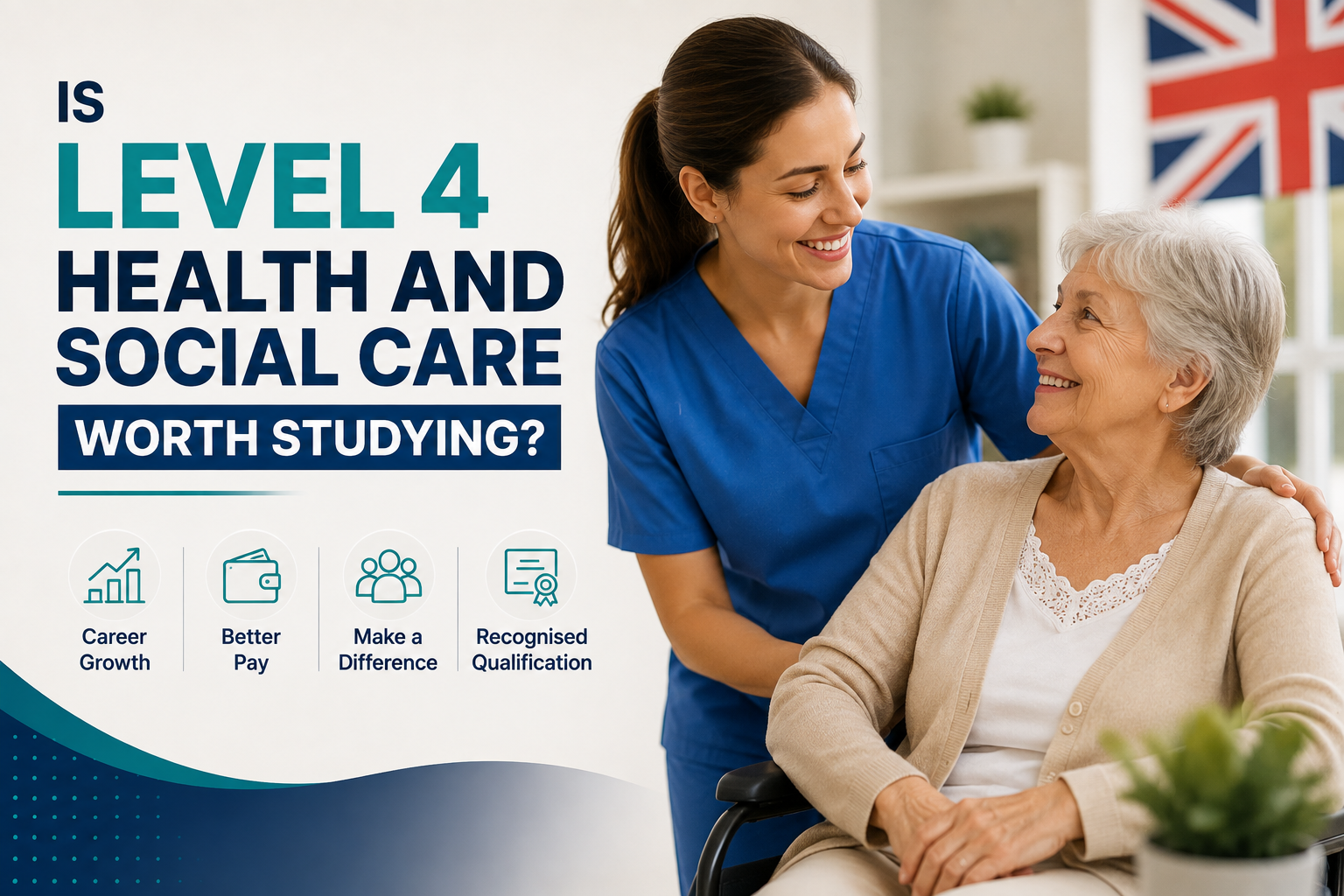
Do you think it is worth studying Level 4 Health and Social care?
If you’re seeking a career in the care industry that is both rewarding and successful, you’ve likely encountered the Level 4 health and social care qualification. However, is it a value for your time, energy and money?
Yes, quite simply, for many learners a level 4 qualification gives them the knowledge, practical skills and confidence to take them beyond entry level roles and into the world of leadership or specialist roles. It also provides a recognised progression to further education and training.
If you’re in the care industry or considering changing your career, read this guide to find out why a Level 4 Health and Social care diploma might be one of the best things you do for your future.
What Is a Level 4 Health and Social Care Qualification?
A Level 4 Health and Social Care is an advanced vocational course for students who wish to pursue their study of health and social care practice, as well as leadership and management, to a higher level.
Level 4 is placed above Level 3 and below Level 5 in the qualifications framework in the UK. It is a more advanced form of study which facilitates critical thinking, independent learning and application of knowledge in a real care setting. Depending on the awarding body and University entrance requirements, progression to the second stage of Higher education may also be available with some Level 4 qualifications.
Who Should Study Level 4 Health and Social Care?
A Level 4 qualification is suitable for:
- Looking to further their careers as a Healthcare Assistant
- Senior Care Workers who are looking to take leadership positions
- Support Workers looking to progress in their career.
- People looking to develop their careers in health and social care
- Individuals interested in developing for managerial positions
- Learners aiming to progress to Level 5 and/or university.
An ideal progression from frontline care, Level 4 provides the opportunity to extend skills and work in more responsibility.
Why Is Level 4 Worth Studying?
1. Better Career Opportunities
An additional benefit of studying level 4 is that it opens up more career opportunities. The level 3 qualification is a common qualification for frontline care, while level 4 builds leadership, communication and decision making skills that are looked for by employers when recruiting for supervisory and management roles.
Potential career opportunities include:
- Senior Care Worker
- Team Leader
- Care Coordinator
- Deputy Manager
- Registered Manager
- Healthcare Administrator
- Community Support Manager
- Service Coordinator
This qualification also allows progression to health service management, care management and community services.
2. Increased Earning Potential
In general, the more qualifications you have, the more responsibility you will be given and this can translate into better pay.
Typical salary ranges include:
| Job Role | Typical Salary |
| Senior Care Worker | £28,000–£38,000 |
| Team Leader | £30,000–£45,000 |
| Care Coordinator | £30,000–£40,000 |
| Deputy Manager | £35,000–£45,000 |
| Registered Manager | £38,000–£65,000+ |
Experience is very important, but advanced qualifications may be a plus when it comes to securing a job as a leader.
3. Develop Leadership and Management Skills
Level 4 is more focused than entry level qualifications on management of people and improvement of services.
You can expect to develop skills in areas such as:
- Leadership
- Team management
- Safeguarding
- Healthcare policy
- Quality assurance
- Communication
- Reflective practice
- Service improvement
- Professional ethics
These transferable skills are useful in hospitals, residential care, community, charities and private healthcare organisations.
4. A Pathway to Further Study
Level 4 is not the end goal for many learners but is a stepping stone to further and higher qualifications.
Depending on your chosen qualification and university requirements, you may progress to:
- Level 5 Health and Social Care
- Foundation Degree
- Bachelor’s Degree
- Nursing
- Social Work
- Public Health
- Healthcare Management
- Occupational Therapy
Level 4 qualifications are recognised by many universities and have varying entry requirements.
5. Strong Demand Across the UK
Health and social care remains one of the biggest employer industries in the UK and will be a continuing strong employer sector, due to the growing need for health and social care in the community and an aging population.
Leaders are especially sought after as organisations strive to enhance service quality, staff development and patient outcomes. Health and social care qualifications can be used to help build a career in health, education, social care and public services.
What Will You Learn?
Although course content varies between awarding organisations, a typical Level 4 Health and Social Care programme covers topics such as:
- Communication in health and social care
- Managing people
- Healthcare policy
- Reflective practice
- Safeguarding
- Sociology and health
- Professional development
- Leadership principles
- Service delivery
- Person-centred care
These modules aim to enable the learner to be prepared for work based tasks and further study.
Is Level 4 Right for You?
A Level 4 qualification is a good choice if you want to:
- Progress into management
- Improve your employability
- Increase your earning potential
- Gain recognised professional skills
- Continue to higher education
- Build confidence in leadership roles
If you are looking to start working in care, you may only require a level 3 qualification. If you are thinking of a career, though, that is longer term with potential of progression then there are definite benefits to Level 4.
Why Study Level 4 Health and Social Care with LCPS?
We know that many students at London College of Professional Studies (LCPS) are juggling work, family and study. This is why we have created our Health and Social Care programmes to be flexible yet maintain quality in learning.
LCPS offering these level 4 health and social care courses,
- ATHE Level 4 Extended Diploma in Health and Social Care
- OTHM Level 4 Diploma in Health and Social Care Management
- OTHM Level 4 Online Diploma in Health and Social Care Management
From moving further up the career ladder to continuing your education to boosting your professional credentials, LCPS can assist you in meeting your goals.
Conclusion
But, should you study Health and Social Care Level 4?
Yes for learners wishing to move on from entry level care roles. The qualification also enables students to build on their knowledge, leadership abilities and confidence within their profession and provide opportunities for progression onto more rewarding roles and higher education.
The health and social care sector is expanding and employers are increasingly seeking individuals who not only have experience of working with people in care but who also have leadership and decision-making skills. A Level 4 qualification can be an advantage and help you to reach your future career goals
When it’s time to invest in your future, studying Health and Social Care Level 4 with LCPS might be the next step towards a career that will be fulfilling and rewarding.
Frequently Asked Questions
Q1. Is Level 4 Health and Social Care equivalent to a university degree?
No. A Level 4 qualification is not a university qualification. This is equivalent to the first year of university study, but the level of the awarding organisation and the university’s admissions policy will determine the level of equivalence for university credit.
Q2. What jobs can I get with a Level 4 Health and Social Care qualification?
Depending on the employer and your experience you may aspire to work as a Senior Care Worker, Team Leader, Care Coordinator, Deputy Manager, Registered Manager, Healthcare Administrator or Community Support Manager.
Q3. Can I study Level 5 after completing Level 4?
Yes. A number of learners move on to a level 5 Health and Social Care qualification or further HE as per entry requirements of the chosen institution.