
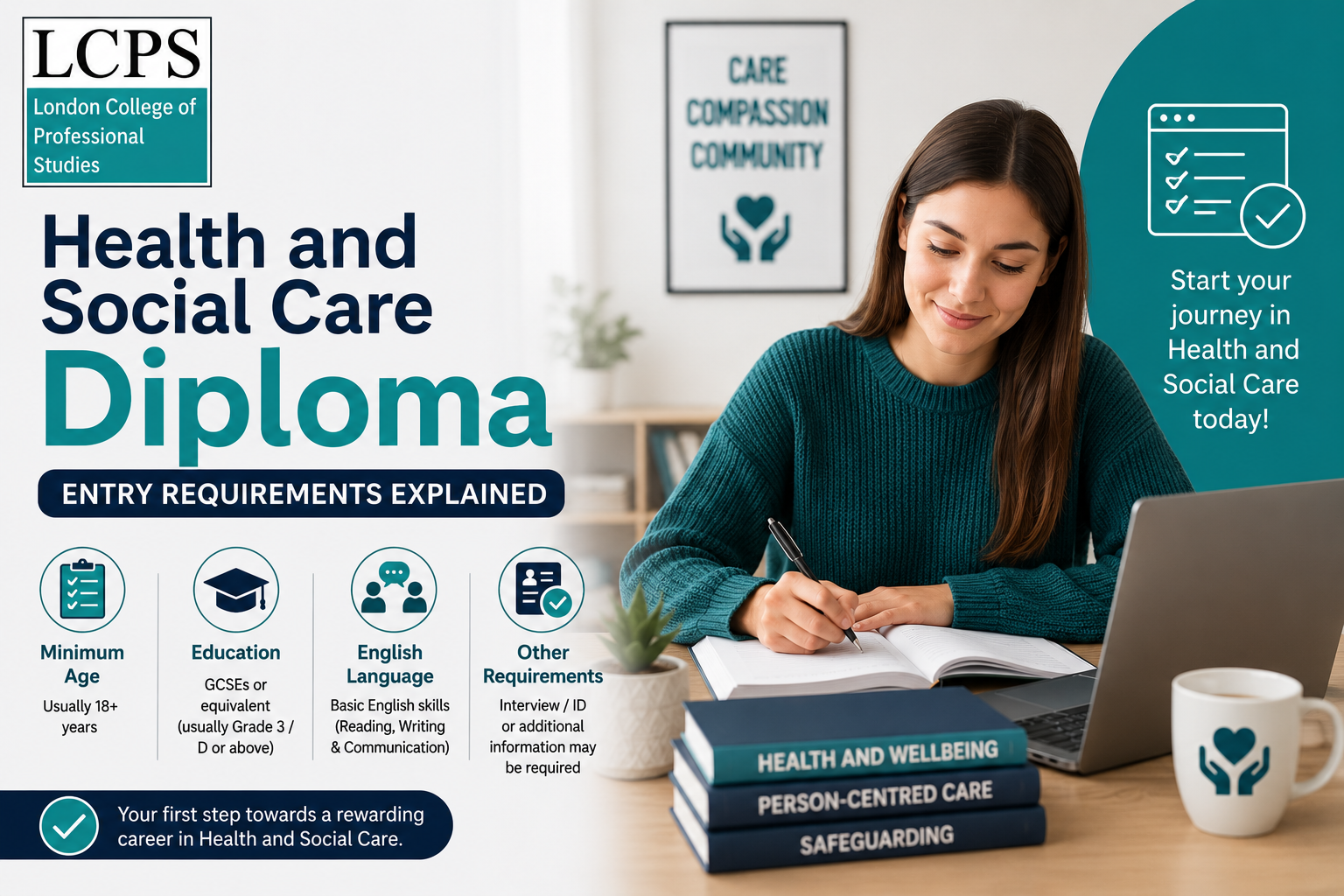
Health and Social Care Diploma entry requirements vary depending on the exact qualification you want to study. Some courses have few formal academic requirements, while others may ask for previous Level 3 or Level 4 study, evidence of English-language ability, relevant professional experience or access to a care workplace.
This is why looking at the qualification level alone can be misleading.
Two diplomas can both be called “Level 3 Health and Social Care”, yet one may be mainly knowledge-based while another requires you to demonstrate competence in a real care setting. The same difference appears at Level 5, where an academic Health and Social Care Management diploma can have a very different entry profile from an occupational Adult Care leadership qualification.
Before applying, check three things first: the exact qualification title, the awarding organisation and the assessment requirements.
The Department of Health and Social Care’s Care Workforce Pathway for Adult Social Care also reflects a wider point about career development. Progression in adult social care in England involves knowledge, skills, workplace experience and continued professional development rather than qualifications alone.
Understanding the entry requirements before enrolling helps you choose a course that fits where you are now rather than simply choosing the highest level available.
Is There One Entry Requirement for Every Health and Social Care Diploma?
No.
There is no universal set of entry requirements covering every Health and Social Care Diploma in the UK.
Requirements can vary according to:
- qualification level;
- awarding organisation;
- type of qualification;
- previous education;
- age;
- English-language ability;
- professional experience;
- whether workplace assessment is required.
Awarding organisations such as OTHM, ATHE, TQUK and NCFE offer qualifications for different purposes.
OTHM’s Level 3 Foundation Diploma in Health and Social Care, for example, does not specify formal academic entry requirements, although applicants must be capable of completing Level 3 study.
The TQUK Level 3 Diploma in Adult Care takes a different approach. It also has no specific formal academic entry requirement, but Level 2 literacy and numeracy are recommended and applicants must be in paid or voluntary work so their competence can be assessed.
The qualification number might be the same level, but the route into it can be quite different.
That is why the safest question is not simply:
“What are the requirements for Level 3?”
It is:
“What are the requirements for this exact Level 3 qualification?”
Health and Social Care Diploma Entry Requirements at a Glance
The table below shows typical examples. These are not universal rules and should always be checked against the current qualification specification.
| Qualification Example | Typical Entry Position | Workplace Requirement |
|---|---|---|
| NCFE CACHE Level 2 Adult Social Care Certificate | Designed for people developing adult-care knowledge and competence | At least 40 hours of work, volunteering or practical placement |
| OTHM Level 3 Health and Social Care | Applicants aged 16+; no specified formal academic prerequisite | Check the exact programme and assessment requirements |
| TQUK Level 3 Diploma in Adult Care | No specific formal entry qualification; Level 2 literacy and numeracy recommended | Paid or voluntary work required for assessment |
| ATHE Level 4 Health and Social Care | Normally Level 3/A Level/Access to HE or equivalent international study | Work experience may be useful but is not a universal entry requirement |
| OTHM Level 4 Health and Social Care Management | Relevant Level 3, two A Levels/equivalent or an appropriate mature-entry route | Qualification-specific |
| ATHE Level 5 Health and Social Care | Normally relevant Level 4 study or equivalent | Qualification-specific |
| OTHM Level 5 Health and Social Care Management | Relevant Level 4, three A Levels/equivalent or mature management experience | Qualification-specific |
| TQUK Level 5 Leadership and Management for Adult Care | No specific formal academic prerequisite; Level 2 literacy/numeracy recommended and minimum age guidance applies | Occupational management qualification; assessment requirements should be checked before enrolment |
The important phrase here is “qualification-specific”.
A Level 5 course does not automatically require the same background as every other Level 5 course.
What Are the Entry Requirements for a Level 2 Health and Social Care Qualification?
Level 2 qualifications can provide an early route into adult social care learning, but “beginner level” does not necessarily mean there are no practical requirements.
A good example is the NCFE CACHE Level 2 Adult Social Care Certificate.
NCFE states that people taking this qualification must spend at least 40 hours working, volunteering or on practical placement so they can demonstrate competence in both knowledge and practical skills.
This is an important distinction.
Someone may be new to formal Health and Social Care study but still need access to a suitable care environment while completing the qualification.
So before enrolling on Level 2, check whether the course is:
knowledge-based, where learning can mainly be demonstrated through study and assessment;
or
competence-based, where you also need to show what you can do in practice.
What Are the Entry Requirements for Level 3 Health and Social Care?
Level 3 is often chosen by people building their knowledge of care or preparing for further study, but completing Level 2 first is not universally compulsory.
Different awarding organisations use different entry profiles.
OTHM Level 3 Health and Social Care
OTHM states that its Level 3 Foundation Diploma in Health and Social Care can be offered from age 16 and that it does not specify formal academic entry qualifications. The approved centre must instead be satisfied that an applicant has the ability to undertake the learning and assessment successfully.
Applicants from countries where English is not the majority language may also need to demonstrate English-language competence.
This means someone does not automatically need GCSEs or a Level 2 Health and Social Care qualification to be considered for this particular route.
TQUK Level 3 Diploma in Adult Care
The TQUK route has a different purpose.
TQUK states that its Level 3 Diploma in Adult Care has no specific formal entry requirements, although learners should have Level 2 literacy and numeracy or equivalent. The recommended minimum age is 16.
More importantly, learners must be in paid or voluntary work because workplace competence needs to be assessed.
That distinction matters enormously.
You could meet the academic entry requirements but still be unable to complete the qualification if you do not have access to the workplace evidence it requires.
If you are still deciding whether Level 3 matches your current stage, the LCPS Level 3 Health and Social Care guide explains the level in more detail.
Can You Start Level 3 Without Completing Level 2?
In some cases, yes.
There is no rule saying every applicant must complete Level 2 before beginning every Level 3 Health and Social Care qualification.
For example, OTHM does not specify a formal Level 2 prerequisite for its Level 3 Foundation Diploma.
ATHE takes another approach. Its Level 3 Health and Social Care entry profile for people recently in education may include five GCSEs at grade 4/C or above, related Level 2 subjects or equivalent international qualifications.
So the answer depends on the course.
You should never assume that completing every qualification level in order is compulsory.
What Are the Entry Requirements for Level 4 Health and Social Care?
Level 4 courses usually expect a stronger academic foundation than many Level 3 routes.
However, saying that all Level 4 applicants must already work as Senior Care Workers or Team Leaders would be inaccurate.
Some Level 4 programmes have mainly academic entry profiles.
OTHM Level 4 Health and Social Care Management
OTHM says the typical entry profile for its Level 4 Diploma in Health and Social Care Management includes at least one of the following:
- a relevant Level 3 Diploma or equivalent;
- GCE Advanced Level achievement in two subjects or equivalent;
- for mature applicants over 21, relevant management experience accepted by the delivery centre.
Applicants from non-majority English-speaking countries must also provide evidence of English-language competence.
ATHE Level 4 Health and Social Care
ATHE’s Level 4 route is different again.
Its current entry profile may include two or more A Level subjects supported by five GCSEs at grade 4/C or above, a related Level 3 qualification, an Access to Higher Education qualification or an equivalent international qualification.
This shows why previous care employment should not automatically be described as mandatory for every Level 4 Diploma.
Professional experience may make the learning more meaningful, but admission still depends on the exact course.
For a broader discussion of this stage, read Is Level 4 Health and Social Care Worth Studying?.
Can You Start Level 4 Without Completing Level 3?
Potentially, yes.
A Level 3 Diploma is only one possible entry route for some Level 4 qualifications.
OTHM, for example, may also consider an appropriate A Level profile or a mature applicant aged over 21 with relevant management experience.
ATHE likewise recognises several routes, including A Levels, Access to HE and equivalent international qualifications.
So if you have not completed a Health and Social Care Level 3 Diploma, do not automatically assume Level 4 is closed to you.
Check whether your existing qualifications or experience meet one of the alternative routes.
What Are the Entry Requirements for Level 5 Health and Social Care?
Level 5 is where the phrase “Health and Social Care Diploma” becomes particularly broad.
Some Level 5 courses are designed around academic progression and Health and Social Care Management.
Others are occupational qualifications aimed at people developing leadership and management capability in adult care.
Those routes can have very different entry requirements.
OTHM Level 5 Health and Social Care Management
OTHM states that its Level 5 Diploma in Health and Social Care Management is typically intended for applicants aged 18 and above.
The expected entry profile includes at least one of the following:
- a relevant Level 4 Diploma or equivalent qualification;
- GCE Advanced Level achievement in three subjects or equivalent;
- relevant management experience for mature applicants aged over 21, subject to centre approval.
Applicants from non-majority English-speaking countries also need evidence of English-language competence.
ATHE Level 5 Health and Social Care
ATHE’s Level 5 Diploma is typically aimed at applicants aged 18 or above.
Its entry profile may include previous Health and Social Care study at Level 4 or above, another relevant Level 4 qualification, a suitable Level 4 apprenticeship achievement or equivalent international qualifications.
For applicants whose first language is not English, ATHE recommends standards including IELTS 5.5, CEFR B2 or an approved equivalent.
TQUK Level 5 Leadership and Management for Adult Care
The TQUK Level 5 Diploma in Leadership and Management for Adult Care has a different entry model.
Its specification states that there are no specific formal entry requirements. Learners should, however, have Level 2 literacy and numeracy or equivalent, and the recommended minimum age is 19.
The qualification is specifically designed to develop knowledge and skills for managers and leaders in care settings.
This is why a generic statement such as “Level 5 requires a Level 4 qualification” would be wrong.
That may apply to one Level 5 route but not another.
If you are trying to decide whether Level 5 suits your current experience, read Who Should Study a Level 5 Diploma in Health and Social Care?.
Can You Start Level 5 Without Completing Level 4?
Sometimes.
For OTHM’s Level 5 Health and Social Care Management Diploma, a relevant Level 4 qualification is one route, but it is not the only route. Applicants may also qualify through an appropriate A Level profile or, for mature applicants, relevant management experience accepted by the centre.
The TQUK Level 5 Adult Care leadership qualification is different again and does not specify a formal Level 4 prerequisite.
So there is no universal rule that says:
Level 3 → Level 4 → Level 5
must always be completed in sequence.
For some people, that is a sensible progression route. For others, previous study or professional experience may provide another entry point.
Do You Need Previous Care Experience?
Not always.
Previous experience may be helpful, but helpful and compulsory are not the same thing.
Some qualifications are suitable for applicants who are still developing their knowledge of the sector. Others are designed around experienced professionals, leadership or management.
Experience becomes particularly relevant when:
- a mature-entry route depends on professional experience;
- workplace competence must be demonstrated;
- management responsibilities form part of the qualification;
- assignments require the application of knowledge to professional practice.
For example, mature applicants over 21 may be considered for OTHM Level 4 or Level 5 Health and Social Care Management through relevant management experience.
But an applicant entering OTHM Level 3 is not given the same formal experience requirement.
The answer therefore depends on which diploma you are applying for.
Do You Need to Be Working in Care?
Again, not for every qualification.
But some Adult Care qualifications require workplace access because they assess occupational competence.
The TQUK Level 3 Diploma in Adult Care explicitly requires learners to be in paid or voluntary work so assessment can take place.
The NCFE CACHE Level 2 Adult Social Care Certificate requires at least 40 hours of work, volunteering or practical placement.
Other Health and Social Care qualifications can be more academically focused and may not carry the same requirement.
This distinction is especially important when studying online.
Online delivery does not necessarily mean the whole qualification can be completed without workplace involvement.
Always check the assessment requirements before enrolling.
Do You Need GCSEs to Study Health and Social Care?
No. GCSEs are not required for every Health and Social Care Diploma.
Some qualifications do not specify GCSE requirements at all.
For example, OTHM does not set a formal GCSE prerequisite for its Level 3 Foundation Diploma in Health and Social Care.
ATHE’s Level 4 Diploma, however, gives an entry route that includes two or more A Level subjects supported by five GCSEs at grade 4/C and above. It also recognises alternative routes such as related Level 3 study, Access to HE and international equivalents.
This means not having GCSEs does not automatically prevent you from studying Health and Social Care.
Your previous qualifications, experience and the entry policy of the particular course all matter.
What English Language Requirements Apply?
A good standard of English is important because Health and Social Care qualifications usually involve reading course materials, writing assignments, understanding professional terminology and communicating ideas clearly.
But the formal requirement varies.
OTHM requires applicants from non-majority English-speaking countries to provide evidence of English-language competence for its Level 3, Level 4 and Level 5 programmes discussed above.
ATHE publishes more specific recommendations for applicable Level 4 and Level 5 applicants. These include:
- IELTS 5.5;
- CEFR B2;
- Cambridge English Advanced 162 or above;
- PTE Academic 42–49;
- or an approved equivalent.
This does not mean every Health and Social Care course requires IELTS.
It means you should check the English-language policy attached to the exact awarding organisation and programme.
Can International Applicants Study Health and Social Care Diplomas?
Yes, many Health and Social Care qualifications accept international applicants.
Awarding organisations can recognise appropriate international qualifications as alternatives to UK qualifications.
ATHE, for example, includes equivalent international qualifications among its entry routes at Levels 3, 4 and 5.
Applicants may also need to provide evidence of English-language competence.
However, there is an important distinction:
Being eligible to enrol on an online UK qualification is not the same as being eligible for a UK Student visa, professional registration or employment in the UK.
Those are separate processes with their own requirements.
An international applicant should therefore check both the course requirements and any separate rules connected to their longer-term goal.
Can Mature Applicants Study Health and Social Care?
Yes.
Being away from formal education for several years does not automatically prevent someone from entering a higher-level Health and Social Care programme.
Some awarding organisations explicitly provide mature-entry routes.
OTHM, for example, allows applicants over 21 with relevant management experience to be considered for its Level 4 and Level 5 Health and Social Care Management diplomas, subject to the delivery centre checking the experience before registration.
This can be particularly useful for people who have developed substantial workplace knowledge but do not have the traditional academic qualifications normally associated with higher-level entry.
Professional experience does not automatically replace every qualification requirement, but it can be formally considered on certain routes.
What Documents Might You Need When Applying?
There is no single document checklist for every Health and Social Care Diploma.
Depending on the qualification, you may be asked to provide evidence such as:
- proof of identity;
- previous qualification certificates;
- evidence of English-language proficiency where required;
- details of relevant professional experience;
- employment or placement information where workplace assessment is required.
The exact documents should be confirmed before application.
This is particularly important if admission depends on international qualifications or professional experience, as the provider may need to review that evidence before deciding whether the course is suitable.
How Do You Check Whether You Meet the Entry Requirements?
Before paying for or enrolling on a Health and Social Care Diploma, follow a simple check.
1. Find the Exact Qualification Name
“Level 5 Health and Social Care” is too broad.
Look for the full title, such as:
OTHM Level 5 Diploma in Health and Social Care Management
or
TQUK Level 5 Diploma in Leadership and Management for Adult Care.
Those are different qualifications.
2. Check the Awarding Organisation
The awarding organisation determines the qualification specification.
OTHM, ATHE, TQUK and NCFE do not necessarily use the same entry requirements.
3. Check the Qualification Reference Number
Where available, the qualification reference helps confirm that you are reading information about the correct programme.
4. Check Both Academic and Practical Requirements
Do not stop after finding the academic entry criteria.
Ask whether you also need:
- employment;
- volunteering;
- placement access;
- workplace observations;
- portfolio evidence.
5. Check English Requirements
This is particularly important for international applicants.
Do not assume IELTS is either automatically required or automatically unnecessary.
6. Compare the Course With Your Next Goal
The qualification should make sense for what you want to do after completing it.
Choosing a higher level simply because it sounds more advanced can leave you on a course that does not suit your current knowledge, professional role or intended progression.
Choosing the Right Health and Social Care Diploma with LCPS
London College of Professional Studies offers Health and Social Care courses at different qualification levels and through different awarding organisations.
This gives applicants more choice, but it also makes checking the exact course important.
Someone preparing for their first formal Health and Social Care qualification may need a different route from an experienced care professional developing towards management.
Likewise, someone whose aim is academic progression may choose a different Level 5 programme from someone who wants an occupational Adult Care leadership qualification.
Before enrolling, compare:
what you already have,
what the qualification requires,
and
what you want the qualification to help you do next.
For people balancing study with employment, the LCPS guide on studying Health and Social Care while working full-time can also help when considering delivery and assessment requirements.
Final Thoughts
Health and Social Care Diploma entry requirements depend on the exact qualification, not simply the number written beside the level.
Some Level 3 courses have no specified formal academic prerequisites. Others require workplace access. Level 4 and Level 5 management qualifications may consider previous academic study, while mature applicants can sometimes enter through relevant professional experience.
English-language requirements can also vary, particularly for international applicants.
The safest approach is therefore simple: check the qualification title, awarding organisation, academic entry requirements, English requirements and workplace assessment conditions before applying.
Once those pieces fit your current situation, you can choose a Health and Social Care Diploma with much more confidence — and with a clearer idea of where it can take you next.
Frequently Asked Questions
Q1. Do I need experience to study a Health and Social Care Diploma?
Not always. Some qualifications accept applicants without previous care employment, while others require relevant experience or workplace access. Always check the exact qualification rather than relying on the level alone.
Q2. Can I study Health and Social Care without GCSEs?
Yes, depending on the course. Some qualifications do not specify GCSE entry requirements, while others accept alternatives such as Level 2 or Level 3 qualifications, Access to HE study, international equivalents or mature-applicant experience.
Q3. Can I start Level 3 Health and Social Care without Level 2?
Yes, for some qualifications. OTHM does not specify a Level 2 prerequisite for its Level 3 Foundation Diploma, for example. Other awarding organisations may use different entry profiles.
Q4. Can I start Level 4 without Level 3?
Potentially. Some Level 4 programmes accept A Levels, Access to HE qualifications, equivalent international qualifications or an appropriate mature-entry route instead of a Level 3 Diploma.
Q5. Can I start Level 5 without Level 4?
It depends on the qualification. Some Level 5 programmes normally expect Level 4 study, while others provide alternative academic or experience-based routes. Certain occupational Level 5 qualifications also use different entry criteria.
Q6. Do I need IELTS to study Health and Social Care?
Not always. Some awarding organisations require evidence of English-language competence and may recommend IELTS or an equivalent test for applicants whose first language is not English. Check the exact course requirement.
Q7. Do I need to work in care while studying?
For some qualifications, yes. Competence-based Adult Care courses can require employment, volunteering or practical placement because workplace performance has to be assessed. Other programmes may not have the same requirement.
Q8. Can international applicants enrol?
Many qualifications accept international applicants and equivalent overseas qualifications. English-language requirements may apply. Course eligibility should not be confused with UK visa, professional registration or employment requirements.
Q9. Can mature applicants qualify through work experience?
Some programmes provide mature-entry routes. OTHM, for example, may consider applicants over 21 with relevant management experience for certain Level 4 and Level 5 Health and Social Care Management qualifications.