
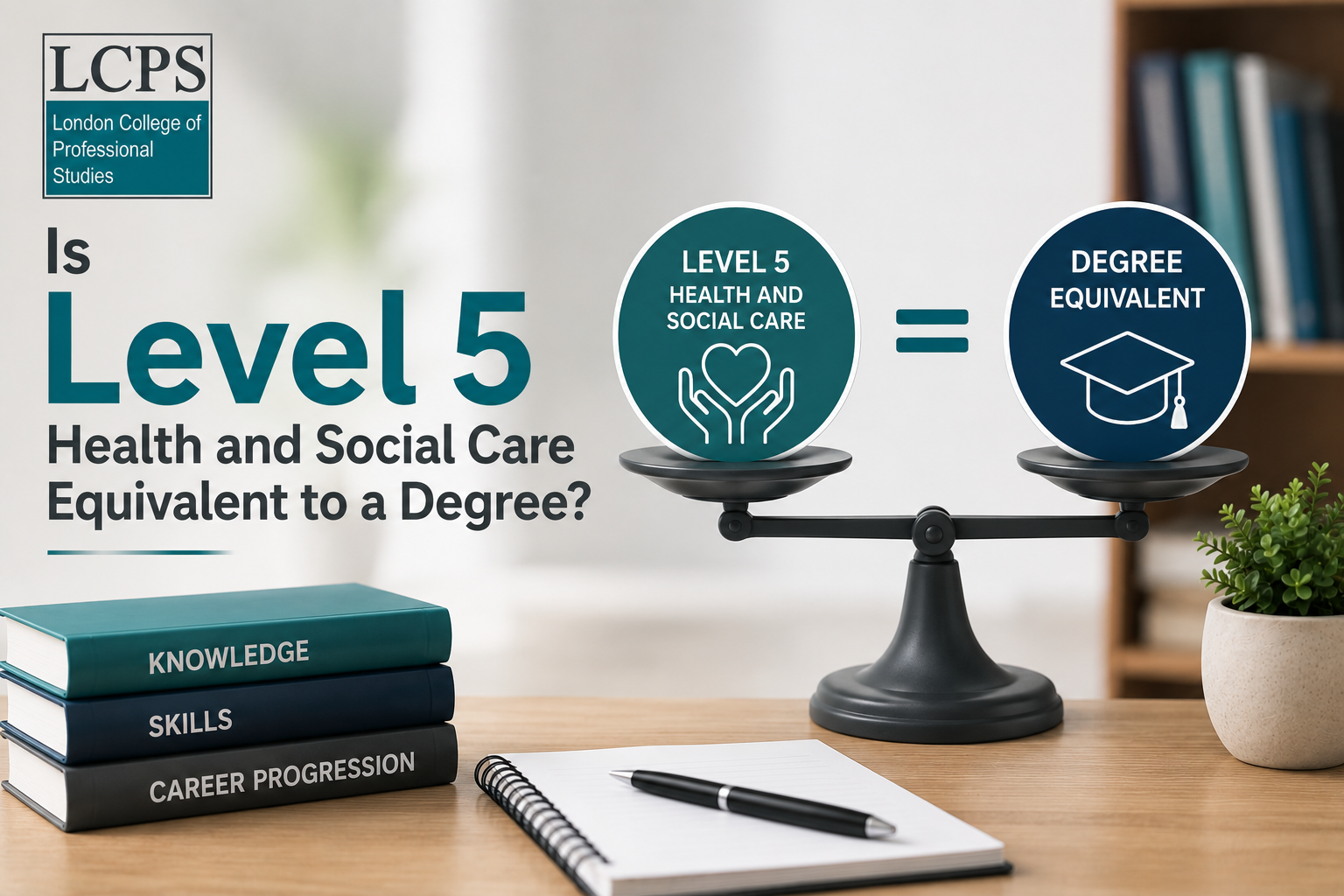
No, a Level 5 Health and Social Care qualification is not equivalent to a bachelor’s degree. In England’s qualification framework, a Level 5 diploma sits at Level 5, while a bachelor’s degree sits at Level 6.
The confusion is understandable because Level 5 also includes higher education qualifications such as Foundation Degrees, Higher National Diplomas (HNDs) and Diplomas of Higher Education (DipHEs). However, qualifications that share the same level are not automatically the same in size, content, assessment or purpose.
For someone working in adult social care, a Level 5 qualification can still be extremely relevant. It may develop the leadership, management and professional knowledge needed for greater responsibility in a care service. Its value does not depend on calling it a degree.
The more useful question is therefore not, “Is Level 5 a degree?” but rather, “What does Level 5 prepare me to do, and does that match where I want my career to go?”
The Department of Health and Social Care’s Care Workforce Pathway for Adult Social Care reinforces this wider view of progression. Careers in adult social care develop through a combination of knowledge, skills, experience and ongoing professional development, rather than through qualifications alone.
The Short Answer: What Is Level 5 Health and Social Care Equivalent To?
A Level 5 Health and Social Care diploma is a Level 5 qualification. It is below a bachelor’s degree, which is Level 6.
The easiest way to see the distinction is through the qualification framework:
| Qualification | Qualification Level |
|---|---|
| Level 3 Diploma | Level 3 |
| Level 4 Diploma | Level 4 |
| Level 5 Diploma | Level 5 |
| Foundation Degree | Level 5 |
| Higher National Diploma (HND) | Level 5 |
| Diploma of Higher Education (DipHE) | Level 5 |
| Bachelor’s Degree | Level 6 |
| Master’s Degree | Level 7 |
The level tells you about the difficulty and complexity of learning. It does not mean that every qualification at that level is interchangeable.
This is an important distinction when comparing a vocational Level 5 diploma with a university qualification.
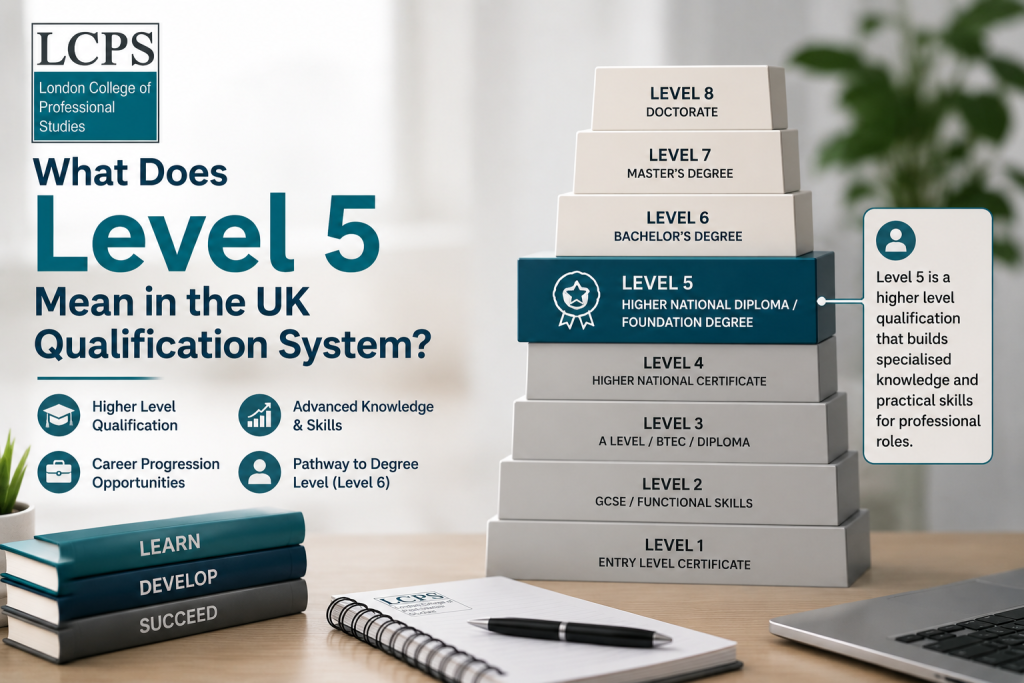
What Does Level 5 Mean in the UK Qualification System?
Qualification levels are used to show how demanding a course or qualification is.
As the level rises, learners are generally expected to deal with more complex information, make stronger judgements and take greater responsibility for applying what they have learned.
Level 5 sits:
above Level 4
and
below Level 6
A Level 5 qualification therefore represents advanced study, but the word “Level” does not tell you everything about the programme.
You also need to consider its:
- qualification type;
- subject;
- size and credits;
- assessment method;
- professional purpose;
- awarding organisation;
- progression opportunities.
GOV.UK explains that qualifications at the same level can still involve different amounts and types of study. You can check the official UK qualification levels on GOV.UK.
That is why saying simply, “Level 5 equals a degree,” is misleading.
Same Level Does Not Mean the Same Qualification
This is perhaps the most important idea in the entire comparison.
Imagine two qualifications sitting on the same shelf. The shelf tells you their level of difficulty, but it does not tell you that the books inside are identical.
The same principle applies to qualifications.
A Foundation Degree can be Level 5.
An HND can be Level 5.
A Level 5 Diploma can also be Level 5.
Yet these qualifications can differ substantially in what they teach, how much study they contain, how they are assessed and what they are designed to achieve.
A vocational Level 5 diploma in adult care may concentrate on managing care services and leading employees. A Foundation Degree may combine academic and vocational study. An HND follows its own higher education structure.
They share a framework level, not a single identity.
What Is a Level 5 Health and Social Care Qualification?
“Level 5 Health and Social Care” is a broad phrase rather than the name of one universal qualification.
Different awarding organisations can offer Level 5 qualifications with different titles, structures and purposes.
Within adult social care, current Skills for Care information includes the Level 5 Diploma in Leading and Managing an Adult Care Service among the qualifications developed for the sector.
Skills for Care describes qualifications as part of workforce development and works with awarding organisations to maintain sector-relevant standards. You can see its current adult social care qualification information.
LCPS also offers the TQUK Level 5 Diploma in Leadership and Management for Adult Care (RQF), which has a specific vocational purpose: developing knowledge relevant to leadership and management in adult care.
It is therefore better to look at the exact qualification title rather than relying only on the phrase “Level 5 Health and Social Care”.
What Does a Level 5 Adult Care Qualification Cover?
A Level 5 qualification aimed at adult-care leadership moves well beyond basic care delivery.
For example, the TQUK Level 5 Diploma offered by LCPS includes areas such as:
- leadership and management in adult care
- governance and regulatory processes
- effective decision-making
- business and resource management
- team leadership and development
- professional supervision
- safeguarding
- mental capacity
- partnership working
- complaints management
- continuous improvement and change
- effective communication
- person-centred practice
- equality, diversity, inclusion and human rights
- health, safety and wellbeing
This gives the qualification a clear professional focus.
Someone studying at this level is not simply learning how care should be delivered. They are also considering how people, systems and services can be led effectively.
Level 5 Health and Social Care vs a Bachelor’s Degree
The difference between a Level 5 diploma and a bachelor’s degree is not only the number printed beside the qualification.
They serve different purposes.
| Area | Level 5 Health and Social Care Diploma | Bachelor’s Degree |
|---|---|---|
| Framework level | Level 5 | Level 6 |
| Typical focus | Vocational or professional development | Higher education study |
| Learning emphasis | Role-related knowledge and application | Academic, theoretical and potentially professional study |
| Career purpose | Can support professional or management development | Can support graduate careers, professional routes or further academic study |
| Assessment | Depends on the qualification; may include assignments and workplace evidence | Depends on the university; may include essays, exams, projects, placements and dissertations |
| Qualification type | Diploma | Degree |
A degree is also not automatically “better” simply because it is Level 6.
The question is what the qualification is meant to achieve.
An experienced adult-care professional who wants to strengthen management knowledge may find a specialist Level 5 vocational qualification highly relevant.
Someone who wants a graduate career requiring a degree, academic research opportunities or a particular postgraduate pathway may need a university qualification instead.
Different destination, different route.
Is Level 5 Equivalent to the Second Year of a Degree?
You may sometimes see Level 5 described as being at a level associated with the second year of undergraduate study.
That comparison can help explain the difficulty level, but it should not be interpreted to mean:
a Level 5 diploma = two completed years of a bachelor’s degree.
A Level 5 diploma does not automatically give you the same credits, curriculum or academic status as two years at university.
Nor does it automatically guarantee direct entry into the final year of a degree. Universities make their own admissions and credit-recognition decisions.
If your goal is university progression, always check whether the exact Level 5 qualification is accepted by the particular university and degree programme you want to enter.
Can a Level 5 Qualification Lead to a Bachelor’s Degree?
It can support further study, but progression is qualification-specific.
Some Level 5 qualifications have routes into:
- Level 6 qualifications;
- degree programmes;
- degree top-up programmes;
- other forms of higher education.
But this should never be treated as an automatic entitlement.
A university may consider:
- the awarding organisation;
- qualification title;
- number of credits;
- subjects studied;
- academic performance;
- English-language requirements;
- how closely the qualification matches the degree;
- its own admissions policy.
Therefore, if a bachelor’s degree is your long-term goal, check university requirements before choosing your Level 5 course.
The safest question to ask is not:
“Can Level 5 lead to a degree?”
but:
“Will this exact Level 5 qualification be accepted for the degree and university I intend to apply for?”
That small change can prevent a very expensive misunderstanding.
Who Should Study a Level 5 Health and Social Care Qualification?
A Level 5 adult-care qualification may be particularly relevant to experienced professionals developing towards leadership or management.
This can include people working as:
- Senior Care Workers;
- Team Leaders;
- Supervisors;
- Deputy Managers;
- professionals already carrying management responsibilities;
- individuals preparing for greater responsibility within adult social care.
At this stage, effective care is no longer only about your own practice.
You may also need to think about the performance of a team, supervision, governance, resources, safeguarding, complaints, improvement and the quality of a service as a whole.
That is where Level 5 study can become valuable.

Can Level 5 Help You Become a Care Manager?
Yes, an appropriate Level 5 adult-care qualification can support progression towards care-management responsibilities, but it does not automatically make someone a Care Manager or Registered Manager.
Management positions depend on more than certificates.
Employers and regulators may also consider:
- relevant experience;
- competence;
- leadership ability;
- communication;
- understanding of safeguarding;
- knowledge of regulatory responsibilities;
- ability to manage employees and services.
The Care Workforce Pathway identifies leadership roles within adult social care, including Deputy Manager and Registered Manager positions, as part of wider career development.
The Care Quality Commission’s Regulation 7 guidance for Registered Managers also makes clear that Registered Managers need the appropriate qualifications, competence, skills and experience for their responsibilities.
A Level 5 qualification can therefore form an important part of a management pathway, but it works alongside practical ability and experience rather than replacing them.
Is Level 5 Better Than a Degree for a Health and Social Care Career?
There is no sensible universal answer.
It depends on the career.
For someone already working in adult social care who wants to develop management knowledge, a specialist Level 5 qualification may provide learning that relates directly to the problems they deal with at work.
For someone whose intended profession specifically requires a degree, a Level 5 diploma will not replace that requirement.
Similarly, someone interested in academic research or wider university study may prefer a degree pathway.
Consider two different ambitions.
Person A already works in an adult care service and is beginning to supervise colleagues. Their next goal is a management role. A vocational leadership qualification may be highly relevant.
Person B wants a profession for which a bachelor’s degree is an entry requirement. They need to follow the appropriate university route.
Neither person is choosing a “better” qualification. They are choosing a qualification for a different destination.
Is Level 5 Health and Social Care Worth Studying?
It can be — if it matches your next step.
Level 5 may offer real value when you want to strengthen knowledge in areas such as:
- leadership
- supervision
- service management
- governance
- safeguarding
- quality improvement
- and team development
Its value becomes much weaker if you choose it simply because you have heard that Level 5 is “almost a degree”.
A qualification should solve a real educational or professional need.
Before enrolling, ask yourself:
- What responsibility do I want next?
- Does this qualification teach the knowledge required for that responsibility?
- Do employers or professional bodies relevant to my goal value this qualification?
- Will I have the experience needed to use what I learn?
- If I want university progression, have I checked the university’s entry requirements?
Those questions are far more useful than comparing qualification names in isolation.
Can You Study Level 5 Health and Social Care Online?
Yes, some Level 5 Health and Social Care and adult-care qualifications are offered through online learning. Online delivery can be especially useful for care professionals who work shifts, have family responsibilities or cannot attend regular classroom sessions. LCPS currently delivers its TQUK Level 5 Diploma in Leadership and Management for Adult Care online. However, there is an important distinction between online course delivery and the assessment requirements of a vocational qualification depending on the exact qualification, practical competence, workplace evidence or access to relevant responsibilities may still matter.
Before enrolling in any online Level 5 course, check:
- exactly who awards the qualification
- whether it is regulated
- the qualification reference number
- entry requirements
- assessment methods
- whether workplace evidence is required
- course duration
- progression opportunities
Flexible learning is useful, but flexibility should never replace checking what the qualification actually requires.
Understanding the Role of the Awarding Organisation and the College
Another source of confusion is the difference between the organisation that awards a qualification and the college that delivers it.
For the LCPS course discussed in this article:
Training Qualifications UK (TQUK) is the awarding organisation.
London College of Professional Studies (LCPS) is the education provider delivering the programme.
LCPS states that it is an approved TQUK centre and currently lists the TQUK Level 5 Diploma in Leadership and Management for Adult Care among its adult-care qualifications.
This distinction matters because the awarding organisation sets the qualification specification, while the provider delivers teaching, support and assessment in line with the relevant requirements.
Study Level 5 Health and Social Care with LCPS
For professionals considering leadership and management development in adult care, LCPS offers the TQUK Level 5 Diploma in Leadership and Management for Adult Care (RQF) through online study.
The programme focuses on areas directly connected with adult-care management, including leadership, governance, decision-making, resource management, team development, supervision, safeguarding and continuous improvement.
You can explore the TQUK Level 5 Diploma in Leadership and Management for Adult Care at LCPS for the current course structure, delivery information, entry requirements and assessment details.
Before enrolling, consider the qualification in the context of your own career.
Ask whether you already have relevant experience, whether leadership is part of your current or intended role and whether the qualification supports the progression route you actually want.
A Level 5 qualification can be valuable, but only when there is a clear reason for studying it.
Should You Choose Level 5 Health and Social Care or a Degree?
Choose according to the destination, not the title.
A Level 5 Health and Social Care or adult-care qualification may make sense if you are looking for focused professional development connected with the care sector, particularly leadership or management.
A degree may be the better route when your intended career requires graduate-level education, you want broader higher education study or you plan to continue into postgraduate education.
And sometimes the two routes can form different stages of a longer education plan.
The crucial point remains the same:
A Level 5 qualification is valuable because of what it teaches and where it can take you — not because it can be described as a degree.
Conclusion
So, is Level 5 Health and Social Care equivalent to a degree? No.
A Level 5 diploma is a Level 5 qualification. A bachelor’s degree is Level 6.
Level 5 does share its framework level with qualifications such as Foundation Degrees, HNDs and Diplomas of Higher Education, but qualifications at the same level should not be treated as identical for an experienced adult-care professional, a vocational Level 5 qualification can still be an important step. It can develop leadership, supervision, governance and service-management knowledge that may support greater responsibility. What matters is not whether the qualification can be made to sound like a degree. What matters is whether it is the right qualification for the work, career or further study you want next.
Frequently Asked Questions
Q1. Is a Level 5 Health and Social Care qualification a degree?
No. A Level 5 Health and Social Care qualification is not a bachelor’s degree. A Level 5 diploma sits at Level 5, while a bachelor’s degree is a Level 6 qualification.
Q2. What is a Level 5 qualification equivalent to in the UK?
Level 5 includes several qualification types, including Level 5 diplomas, Foundation Degrees, HNDs and Diplomas of Higher Education. These qualifications share a level of difficulty but are not automatically identical in size, content, credits or purpose.
Q3. Is Level 5 equivalent to the second year of a bachelor’s degree?
Level 5 may be described as a comparable level of study to that reached during the second year of a standard undergraduate programme, but this does not mean a Level 5 diploma is automatically the same as completing two years of a degree. Credit and university entry decisions depend on the exact qualification and institution.
Q4. Can I progress from Level 5 Health and Social Care to a degree?
Potentially. Some Level 5 qualifications support progression into further higher education, but university admission or advanced entry is not automatic. Check the requirements of the specific university and degree programme.
Q5. Can I become a Registered Manager with a Level 5 qualification?
A relevant Level 5 leadership or management qualification may support progression towards Registered Manager responsibilities, but qualifications alone are not enough. Relevant experience, competence, skills and leadership ability are also important.
Q6. Is Level 5 Health and Social Care worth studying?
It may be valuable for experienced professionals who want to develop leadership and management knowledge in health or adult social care. Its usefulness depends on your existing experience, intended role and progression plans.
Q7. Can Level 5 Health and Social Care be studied online?
Some Level 5 programmes are available online. However, vocational qualifications may have specific practical, workplace or assessment requirements, so check the exact specification before enrolling.
Research and Further Reading
Department of Health and Social Care – Care Workforce Pathway for Adult Social Care
Skills for Care – Adult Social Care Qualifications
Care Quality Commission – Regulation 7: Requirements Relating to Registered Managers