
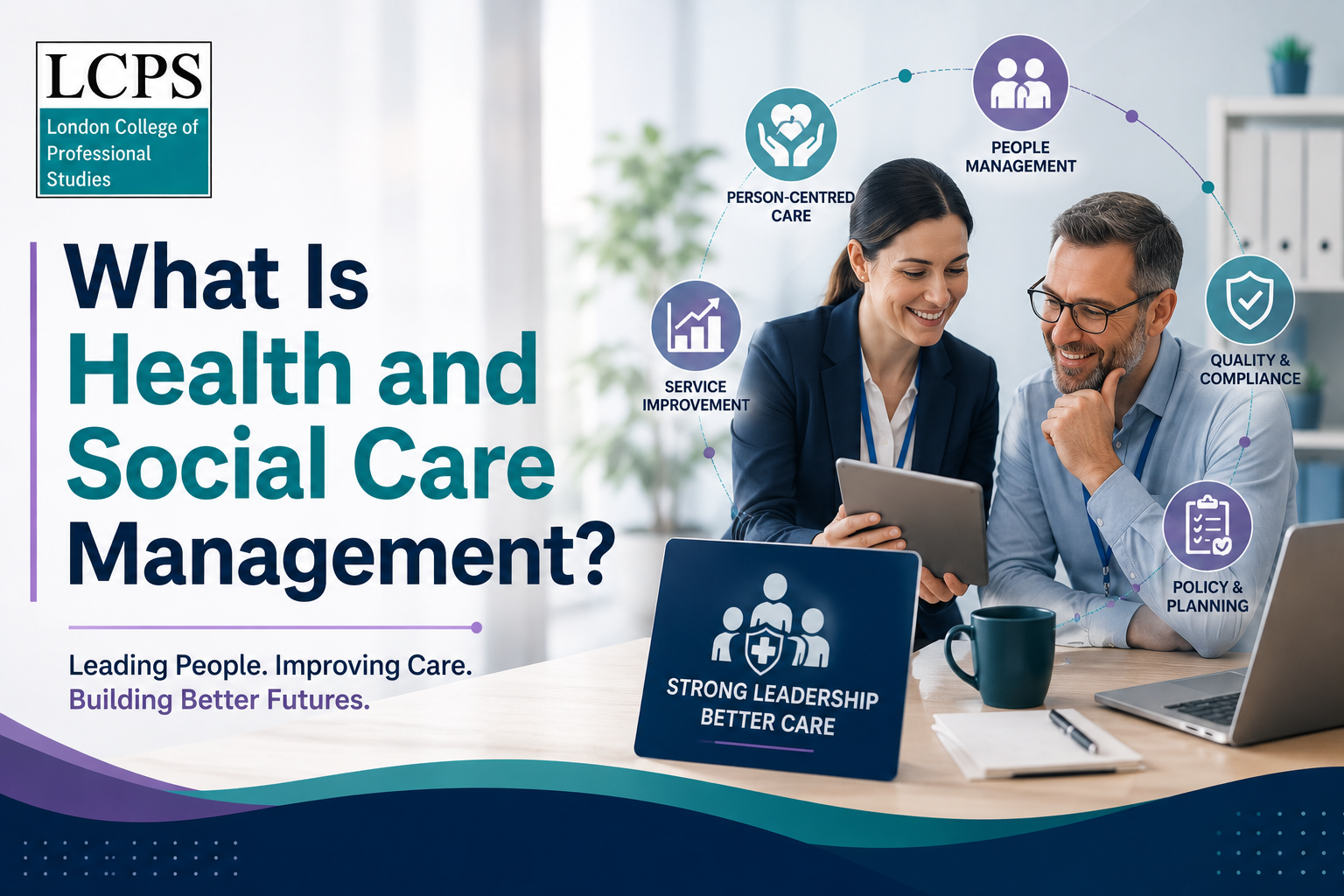
Health and Social Care Management is the study of how care and support services are delivered, organised, led and improved. A Health and Social Care course may focus on areas such as communication, safeguarding, person-centred practice and professional responsibilities, while management-focused study moves further into leadership, teams, quality, resources and service improvement.
The distinction matters.
Someone providing direct care needs to understand how to support people safely and respectfully. Someone moving towards supervision or management also needs to think about how staff are supported, how services maintain quality, how resources are used and how decisions affect the people who draw on care and support.
This is why Health and Social Care qualifications exist at different levels and for different purposes.
Some are designed for people entering or developing within care practice. Others are aimed at professionals moving towards leadership, service management or further higher education.
Understanding what Health and Social Care Management actually involves can help you choose a qualification that fits your experience and the direction you want to take next.
What Is Health and Social Care?
Health and Social Care is a broad field concerned with supporting people’s health, wellbeing, independence and quality of life.
It brings together different types of services and professional responsibilities.
Social care may involve supporting people with everyday living, independence, personal choice, communication, wellbeing and participation in their communities.
Health services can include clinical and non-clinical support concerned with maintaining or improving health.
The two areas often work alongside one another.
For example, a person leaving hospital may require clinical treatment from healthcare professionals while also receiving support at home from social care services.
In England, the Department of Health and Social Care’s Care Workforce Pathway describes adult social care through a wide range of roles, from people who are new to care and Care or Support Workers through to Supervisors, Deputy Managers, Registered Managers and wider organisational roles.
Health and Social Care is therefore not one job. It is a broad field containing different services, responsibilities and professional pathways.
What Is Health and Social Care Management?
Health and Social Care Management looks at what happens when responsibility extends beyond your own individual practice.
A manager or developing leader may need to consider questions such as:
- How should a care team be supported?
- How can a service maintain good standards?
- How should resources be managed?
- How can communication between professionals be improved?
- What happens when practice needs to change?
- How should staff performance and development be supported?
- How can services remain person-centred while also meeting organisational responsibilities?
These are management questions rather than simply care-delivery questions.
That is why higher-level Health and Social Care Management qualifications often include subjects connected with leadership, supervision, quality, partnership working, research, resources, policy and organisational improvement.
A management qualification can therefore be relevant to someone who already works in the sector and is taking on more responsibility, as well as to someone pursuing an academic pathway into wider health and social care leadership.
Health and Social Care vs Health and Social Care Management
The two areas overlap, but their emphasis is different.
| Area | Health and Social Care | Health and Social Care Management |
|---|---|---|
| Main focus | Supporting people and understanding effective care practice | Leading, organising and improving services |
| Typical themes | Communication, safeguarding, equality, person-centred care, wellbeing | Leadership, supervision, quality, resources, teams, policy and service improvement |
| Perspective | Individual care and professional practice | Team, service and organisational responsibility |
| May suit | People developing care knowledge or working in support roles | Experienced professionals, aspiring leaders and management-focused learners |
| Progression | Can support further care-sector study and professional development | Can support higher-level management study and leadership development |
The difference is not that one subject is more important than the other.
Management depends on a good understanding of care.
A person cannot lead a high-quality care service effectively without understanding why safeguarding, dignity, communication, equality and person-centred practice matter.
What Does a Health and Social Care Course Cover?
There is no single curriculum shared by every Health and Social Care course.
What you study depends on the qualification level, awarding organisation and purpose of the programme.
At an earlier stage, learning may concentrate more heavily on professional care practice.
Topics can include communication, safeguarding, equality and diversity, health and safety, wellbeing, professional responsibilities and supporting people with different needs.
At higher levels, the emphasis can change.
For example, OTHM’s current Level 4 Diploma in Health and Social Care Management includes areas such as equality and inclusion, professional development, communication, health and safety, assessment processes and resource management.
This shows an important transition.
You are still studying care, but you are beginning to examine the systems and decisions around its delivery.
For a broader explanation of diploma study, LCPS also has a guide to what a Health and Social Care Diploma is.
What Do You Study in Health and Social Care Management?
As study becomes more management-focused, the questions become broader.
Instead of only asking how one professional should work effectively, learners may begin considering how an entire team or service can perform well.
Current Level 5 Health and Social Care Management study provides a good example.
OTHM’s Level 5 programme develops knowledge around areas including partnership working, managing care, team management, professional supervision and research.
At higher levels, the focus becomes broader still.
OTHM’s Level 7 Health and Social Care Management qualification includes Health and Social Care Leadership, Managing People, Managing Finance, Strategies and Policies, Leading Change and Research Methods.
This illustrates how the subject develops.
At one end, Health and Social Care study is concerned with understanding effective professional practice.
At the other, management study asks how services, people, resources, policy and change can be led.
What Skills Can Health and Social Care Management Study Develop?
The exact skills depend on the qualification, but management-focused study can help develop several areas of professional understanding.
These commonly include:
- communication and partnership working;
- leadership and team development;
- supervision and professional development;
- safeguarding awareness;
- decision-making;
- resource management;
- quality and service improvement;
- research and evidence-based thinking;
- understanding organisational responsibilities;
- policy and strategic thinking at higher levels.
Some of these skills are useful well before someone becomes a formal manager.
A Senior Care Worker supporting colleagues, for example, may already need good communication and leadership skills.
A Team Leader may begin dealing with supervision and service improvement.
A Deputy Manager may need to think more seriously about staff, resources, quality and organisational responsibilities.
Management development is therefore often gradual rather than a sudden jump from Care Worker to Manager.
Is Health and Social Care Management the Same as Nursing?
No.
A general Health and Social Care Management qualification is not the same as professional nursing education.
Nursing is a regulated clinical profession with its own approved education and professional-registration requirements.
Health and Social Care Management focuses more broadly on services, leadership, care systems, professional practice and organisational management.
The same caution applies to other regulated professions such as medicine, dentistry and certain allied health professions.
Completing a general Health and Social Care qualification does not automatically qualify someone to practise in a regulated clinical profession.
This distinction is particularly important for international applicants who may see the words “health” or “healthcare” and assume that a qualification provides professional clinical registration.
It does not.
A qualification should always be considered in relation to the particular career you want.
Who Should Study Health and Social Care Management?
Health and Social Care Management can suit people at different stages, but the correct qualification level matters.
| Current Position or Goal | Study Direction That May Be Relevant |
|---|---|
| New to care | Introductory Health or Adult Social Care learning |
| Developing direct-care knowledge | Relevant Level 2 or Level 3 qualification |
| Experienced Care or Support Worker | Level 3 or Level 4 professional development |
| Senior Care Worker or developing Team Leader | Leadership, supervision or Level 4 development |
| Team Leader / Supervisor | Relevant Level 4 or Level 5 management study |
| Deputy Manager / aspiring manager | Relevant Level 5 leadership or Health and Social Care Management qualification |
| Experienced manager | Level 6 or specialist higher-level study |
| Senior leader / postgraduate applicant | Relevant Level 7 management study |
This is only a guide.
Qualifications with the same level number can have very different purposes.
An occupational Adult Care qualification may assess workplace competence, while an academic Health and Social Care Management programme may place more emphasis on management knowledge, written assessment or progression to higher study.
If you are unsure which level matches your position, read the LCPS comparison of Level 3 vs Level 4 vs Level 5 Health and Social Care.
What Qualification Levels Are Available?
Health and Social Care study can extend across several levels.
LCPS currently offers qualifications from different awarding organisations and for different purposes, so not every route follows exactly the same ladder.
A broad management progression can look like this:
| Level | Typical Academic or Professional Focus |
|---|---|
| Level 3 | Building Health and Social Care knowledge and preparing for further study or professional development |
| Level 4 | Advanced understanding with increasing emphasis on management, professional development and resources |
| Level 5 | Team management, supervision, partnership working and wider service responsibilities |
| Level 6 | Leadership, quality, resource management and advanced organisational understanding |
| Level 7 | Strategic leadership, people management, finance, policy, change and postgraduate-level study |
For example, OTHM currently offers Health and Social Care Management qualifications at Levels 4, 5, 6 and 7, with the curriculum becoming progressively more management and strategy focused.
A higher number, however, is not automatically the better choice.
The appropriate level is the one for which you are academically and professionally prepared.
Do You Need to Complete Every Level in Order?
Not necessarily.
It is easy to imagine Health and Social Care qualifications as a fixed staircase:
Level 2, then Level 3, then Level 4, then Level 5.
Real entry routes can be more flexible.
Some higher-level qualifications accept previous study at the level below. Others may consider A Levels, equivalent international qualifications or relevant experience through a mature-entry route.
Occupational qualifications can also have different workplace requirements from academic management qualifications.
That means someone should not choose a starting point simply by looking at the number.
LCPS’s detailed guide to Health and Social Care Diploma entry requirements explains how requirements differ between OTHM, ATHE, TQUK and NCFE routes.
Do You Need Experience to Study Health and Social Care Management?
It depends on the qualification.
Some programmes expect prior qualifications rather than employment experience.
Others provide mature-entry routes where relevant management experience can be considered.
Occupational Adult Care qualifications may require workplace access because learners must demonstrate professional competence.
Even when experience is not formally required, it can still be valuable.
Management ideas often make more sense when you have seen how a real care service operates.
Concepts such as supervision, partnership working, quality improvement and resource management become easier to understand when they can be connected to real situations.
The key is to distinguish between:
experience that helps you learn
and
experience that is formally required for admission or assessment.
Those are not always the same thing.
Can You Study Health and Social Care Management Online?
Yes, many Health and Social Care Management qualifications can be delivered through online or distance learning.
OTHM, for example, allows approved centres to deliver its Level 4 and Level 7 Health and Social Care Management qualifications through distance and online learning.
Online study can be especially useful for working professionals who need to combine education with shifts, management responsibilities or family life.
However, “online” describes the delivery method. It does not change the academic or practical requirements of the qualification.
You may still need to complete assignments, meet assessment criteria and, for some occupational qualifications, provide workplace evidence.
If working alongside study is important to you, LCPS has a separate guide explaining how Health and Social Care can be studied while working full-time.
Does Health and Social Care Management Lead to a Degree?
Some qualifications can support higher education progression, but this depends on the exact programme and university.
For example, OTHM positions its Level 4 Health and Social Care Management Diploma at the academic level associated with the first year of a three-year UK bachelor’s programme and Level 5 at the level associated with the second year. OTHM also publishes specific university progression arrangements for its Level 4 and Level 5 routes.
That does not mean a Level 4 or Level 5 diploma is itself a bachelor’s degree.
They remain separate qualifications.
University admission, advanced entry and credit recognition depend on the particular qualification and the receiving university.
For a deeper explanation of this distinction, read Is Level 5 Health and Social Care Equivalent to a Degree?.
What Careers Can Health and Social Care Management Study Support?
Health and Social Care qualifications can be relevant to different career stages, but a qualification does not guarantee a particular job, promotion or salary.
In adult social care in England, the Care Workforce Pathway now includes role categories such as Care or Support Worker, Supervisor or Leader, Deputy Manager, Registered Manager and Corporate Management.
This gives a useful picture of how responsibility can develop across the sector.
A possible professional journey might move from direct care into supervision, then deputy management and later broader service leadership.
However, employers consider more than qualifications.
Experience, competence, safeguarding knowledge, communication, leadership ability and the requirements of the individual position can all matter.
Skills for Care also places qualifications within a wider approach to workforce learning and development rather than treating them as automatic job tickets.
For people specifically interested in management progression, the LCPS guide on how to become a Care Manager in the UK explores this route in more detail.
Does a Health and Social Care Qualification Guarantee Promotion or Higher Pay?
No.
A qualification can strengthen knowledge and may support an application for greater responsibility, but it does not automatically make someone eligible for a promotion or pay increase.
Employment decisions depend on the employer and role.
Factors can include professional experience, performance, competence, job availability, leadership ability, contractual arrangements and the organisation’s requirements.
This is why the value of a qualification should not be measured only by whether it immediately changes someone’s job title.
Learning can also help a professional understand their responsibilities better, prepare for future progression or meet the entry requirements for further study.
How Is Adult Social Care Management Changing?
Adult social care in England is placing greater emphasis on clearer career development and workforce capability.
The Care Workforce Pathway was expanded in July 2026 and now covers 18 direct and supporting role categories across adult social care, including Care or Support Workers, Supervisors or Leaders, Deputy Managers, Registered Managers, Corporate Management and Quality Assurance roles.
The significance of this is not that everyone follows one identical career ladder.
It is that the sector increasingly recognises different stages of responsibility and the knowledge, skills, values and behaviours needed at each stage.
Management development sits within that wider picture.
A strong manager needs more than a qualification. They need to understand the people receiving support, the staff delivering it and the systems that allow a service to work well.
How Do You Choose the Right Health and Social Care Course?
Start with your goal rather than with the course title.
Ask what you want the qualification to help you do.
If you are developing care-practice knowledge, an occupational or earlier-level qualification may make more sense, or If you are beginning to supervise colleagues, a programme with leadership content may be useful and If your aim is broader management or higher education progression, a Health and Social Care Management qualification may be more appropriate.
Before enrolling, check:
- the exact qualification title,
- the awarding organisation,
- entry requirements,
- assessment method,
- whether workplace evidence is required,
- the units you will study,
- and the progression routes available afterwards.
A qualification should fit your next step, not simply have the highest level number.
Study Health and Social Care Management with LCPS
London College of Professional Studies offers a range of Health and Social Care courses covering different levels and purposes.
Current LCPS options include qualifications from awarding organisations such as OTHM, ATHE, TQUK and NCFE.
This gives applicants several possible routes, but it also makes careful comparison important.
Someone seeking an occupational Adult Care qualification may need something different from someone pursuing academic Health and Social Care Management study.
Likewise, a professional preparing for leadership may need a different programme from someone who is completely new to the care sector.
Before applying, compare your current education, experience and responsibilities with the entry and assessment requirements of the exact qualification.
The right Health and Social Care course should give you a clearer next step rather than simply another certificate.
Conclusion
Health and Social Care Management is about more than supervising people.
It brings together an understanding of care with the wider responsibilities involved in running and improving services.
At earlier stages, Health and Social Care study can help develop an understanding of communication, safeguarding, equality, wellbeing and professional practice. As study progresses, the focus can move towards leadership, supervision, teams, resources, quality, policy and organisational change.
That progression is why choosing the right course matters.
A new Care Worker, an experienced Team Leader and a senior manager do not necessarily need the same qualification.
The best starting point is therefore to understand where you are now, what responsibility you want next and what the exact qualification is designed to teach.
Once those three things line up, Health and Social Care study can become part of a much clearer professional or academic pathway.
Frequently Asked Questions
Q1. What is Health and Social Care Management?
Health and Social Care Management is the study of how health and care services are organised, led and improved. It can include leadership, teams, supervision, resources, quality, safeguarding, partnership working, policy and service development.
Q2. What is the difference between Health and Social Care and Health and Social Care Management?
Health and Social Care study often focuses more directly on care practice and supporting people’s wellbeing. Health and Social Care Management extends into leadership, supervision, teams, resources and the organisation of services.
Q3. Is Health and Social Care Management the same as nursing?
No. Nursing is a regulated clinical profession with separate professional education and registration requirements. A general Health and Social Care Management qualification does not qualify someone as a nurse.
Q4. Do I need to already work in care?
Not for every qualification. Requirements vary between awarding organisations and programmes. Some qualifications use academic entry requirements, while occupational courses may require workplace access or professional experience.
Q5. Can Health and Social Care Management be studied online?
Yes. Many management qualifications can be delivered through online or distance learning by approved centres. The exact assessment and workplace requirements still depend on the qualification.
Q6. Which level of Health and Social Care should I study?
The appropriate level depends on your previous qualifications, experience and goal. Earlier levels may suit people developing care knowledge, while Levels 4 and 5 can support more advanced or management-focused study. Levels 6 and 7 move further into leadership and strategy.
Q7. Can Health and Social Care Management lead to a management job?
A relevant qualification can develop knowledge useful for management responsibilities, but it does not guarantee a particular role. Employers may also consider experience, competence, leadership ability and the requirements of the position.
Q8. Can a Health and Social Care qualification lead to university?
Some qualifications provide routes into further higher education, but progression depends on the exact qualification and the admissions requirements of the university concerned.



Leave a Reply