
What Is Level 3 Health & Social Care?
If you’re thinking about a career in health and social care, you’ve probably come across Level 3 qualifications. But what does Level 3 Health & Social Care actually means? Is it the right qualification for you, and what jobs can it lead to? these are the questions many learner are looking for.
A Level 3 Health & Social Care qualification is one of the most popular routes in the healthcare and social care sectors, It helps learners develop the knowledge, practical skills, and professional understanding needed to work in care settings or continue their education at a higher level. Whether you’re leaving school, changing careers, or already working in care, Level 3 can open the door to a wide range of opportunities.
This guide explains everything you need to know, including what you’ll learn, who the qualification is for, entry requirements, career options, salary expectations, and how it can support your long-term career goals.
Level 3 Health & Social Care at a Glance
| Qualification Level | Level 3 |
| Equivalent To | A Levels |
| Regulated By | Ofqual (for regulated qualifications) |
| Suitable For | School leavers, adults, career changers, care workers |
| Study Options | Online, blended learning, classroom |
| Typical Duration | 6–18 months |
| Progression | Employment, Level 4, Level 5, university |
What Does Level 3 Mean?

In the UK, qualifications are organized using the Level 3 sits above Level 2 and are generally considered equivalent in academic level to A Levels. However, unlike traditional academic qualifications, Level 3 Health & Social Care focuses on developing practical knowledge that can be applied in real healthcare and social care environments.
Instead of studying purely theoretical subjects, learners develop skills that employers value every day.
These include:
- Communication
- Safeguarding
- Person-centred care
- Health and safety
- Equality and diversity
- Professional practice
- Supporting wellbeing
Many Level 3 qualifications also prepare learners for higher education, making them suitable for people who eventually want to study nursing, social work, healthcare management, or other related subjects.
Why Is Level 3 Health & Social Care Important?
Healthcare has changed significantly over the last decade, people are living longer, more individuals require long-term support, and healthcare professionals are caring for people with increasingly complex needs.
This means employers need staff who understand more than just basic care.
Today’s care professionals need to:
- Communicate confidently
- Work as part of multidisciplinary teams
- Protect vulnerable individuals
- Follow professional standards
- Deliver person-centred care
- Adapt to different care settings
A Level 3 qualification helps learners develop these skills while building confidence to work professionally within health and social care services.
For many employers, completing a recognised Level 3 qualification demonstrates commitment, knowledge, and readiness for greater responsibility.
Who Is Level 3 Health & Social Care For?
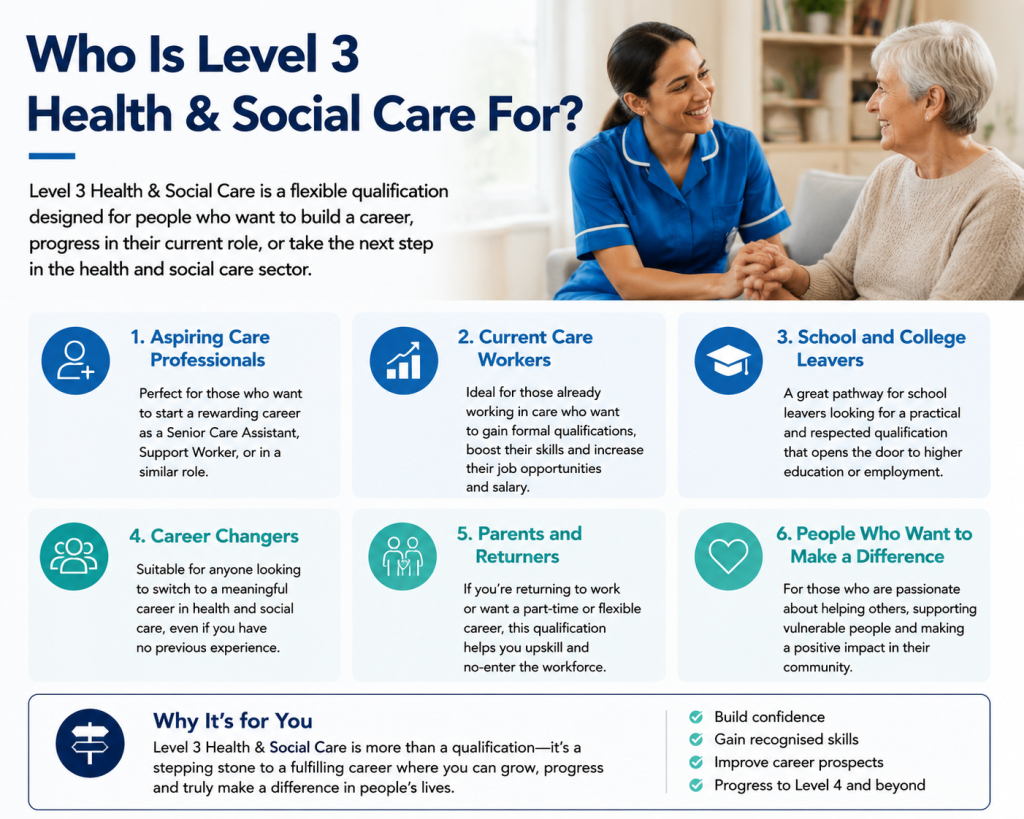
One of the biggest strengths of this qualification is its flexibility you can do it from anywhere and anytime. It is suitable for people at different stages of their education and career.
School Leavers
Most of the students choose Level 3 after completing GCSEs because it provides a practical alternative to purely academic study.
It also creates progression opportunities into university or employment.
Students interested in nursing, healthcare, psychology, public health, social work, or adult care often begin with a Level 3 qualification.
Adults Returning to Education
Many adults decide to retrain later in life.
Whether you’re returning to work after raising a family or looking for a more rewarding career, Level 3 provides a recognised route into health and social care.
Previous healthcare experience is not always required.
Career Changers
People change their career and move into health and social care from sectors such as:
- Retail
- Hospitality
- Customer service
- Administration
- Warehousing
- Education
These industries often develop transferable skills like communication, teamwork, organisation, and problem-solving, all of which are valuable in care settings.
Existing Care Workers
Existing Care Assistants, Support Workers, Healthcare Assistants, and Domiciliary Care Workers study Level 3 to develop their knowledge and improve career prospects.
The qualification can support progression into:
- Senior Care Assistant
- Team Leader
- Care Coordinator
- Specialist Support Worker
- Deputy Manager
Most employers also encourage existing staff to complete Level 3 qualifications as part of their professional development.
Entry Requirements
Entry requirements can vary depending on the qualification and training provider.
Many Level 3 programmes are suitable for learners who have:
- Completed a Level 2 qualification
- Relevant workplace experience
- GCSEs or equivalent qualifications
- A good standard of English
Some providers also accept mature learners who can demonstrate suitable experience or the ability to study at Level 3.
Always check the specific entry requirements before applying.
How Long Does a Level 3 Health & Social Care Course Take?
The time needed to complete a Level 3 qualification depends on the study method, course structure, and personal circumstances.
Typical completion times include:
| Study Mode | Typical Duration |
| Full-Time | 6–12 months |
| Part-Time | 9–18 months |
| Flexible Online Learning | Varies depending on study pace |
Many online learners choose flexible study because it allows them to balance education with work, family responsibilities, or existing employment and this flexibility makes Level 3 Health & Social Care accessible to a wide range of learners across the UK and all over the world.
Can You Study Level 3 Health & Social Care Online?
Yes.
Many recognised providers now offer flexible online or blended learning options.
Online study allows learners to:
- Study around work commitments
- Learn at their own pace
- Access learning materials remotely
- Receive tutor support throughout the course
For adults balancing employment or family responsibilities, flexible learning can make gaining a recognised qualification much more manageable.
What Will You Learn on a Level 3 Health & Social Care Course?
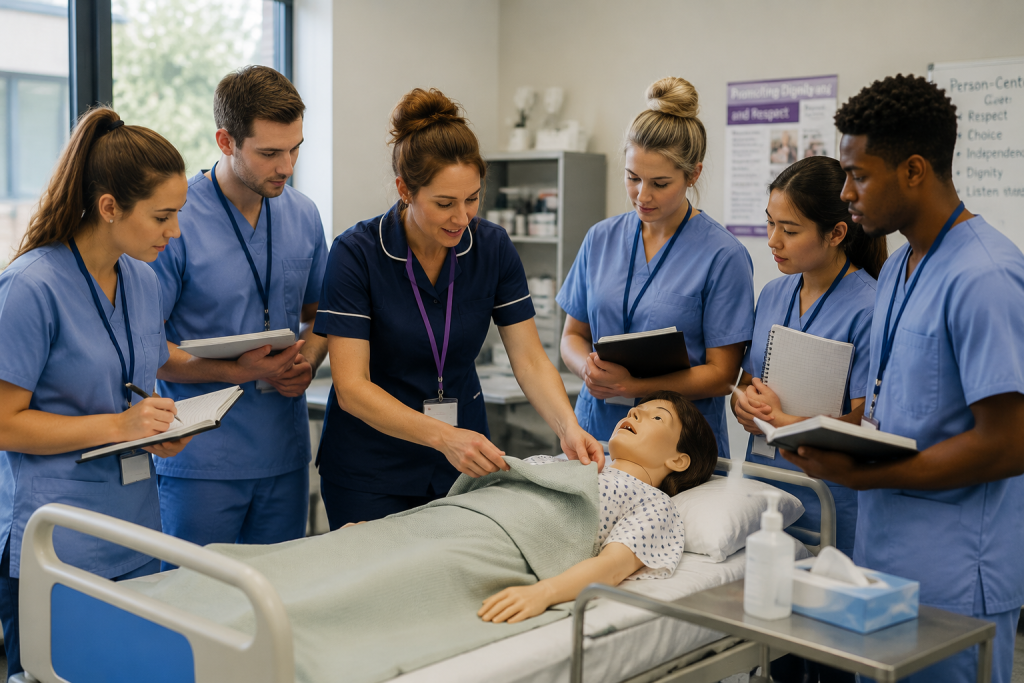
A Level 3 Health & Social Care qualification is designed to prepare learners for real-world care settings, rather than focusing only on theory, the course combines practical knowledge with professional skills that can be used in healthcare and social care environments.
While course content may be change a bit, between awarding organisations, but most programmes cover the same core topics that employers expect care professionals to understand.
Core Subjects
- Communication in health and social care
- Safeguarding adults and children
- Equality, diversity, and inclusion
- Health and safety
- Person-centred care
- Professional responsibilities
- Duty of care
- Confidentiality
- Mental health awareness
- Infection prevention and control
- Promoting health and wellbeing
- Partnership working
These topics help learners understand how to provide safe, effective, and compassionate care.
Practical Skills You’ll Develop
One of the biggest advantages of studying Level 3 is the focus on workplace skills and most Employers are looking for people who can work confidently with colleagues, communicate professionally, and support individuals with different needs.
Throughout the course, learners develop skills such as:
Communication
Good communication is at the centre of quality care.
- Individuals receiving care
- Families
- Colleagues
- Healthcare professionals
- External agencies
The course also explores how communication methods should be adapted to meet different needs.
Person-Centred Care
Every individual has different needs, preferences, beliefs, and goals.
Person-centred care focuses on treating people with dignity while supporting them to make choices about their own lives.
This approach is used throughout modern health and social care services and is one of the most important principles learners develop during Level 3 study.
Safeguarding
Safeguarding is a key responsibility in every health and social care role.
- Different types of abuse
- Recognising signs of neglect
- Protecting vulnerable adults and children
- Reporting concerns
- Professional responsibilities
These skills help create safer environments for everyone receiving care.
Professional Practice
Health and social care professionals are expected to work responsibly and ethically.
- Confidentiality
- Professional boundaries
- Accountability
- Record keeping
- Ethical decision-making
- Working within policies and procedures
These skills build confidence and prepare learners for employment.
What Skills Do Employers Look For In HSC Qualified Individual?
Most Employers are looking for these qualities from HSC qualified individual
- Communication
- Teamwork
- Problem-solving
- Organisation
- Compassion
- Empathy
- Professional behaviour
- Time management
- Record keeping
- Critical thinking
These transferable skills are valuable across hospitals, care homes, supported living services, community healthcare, and many other settings.
Benefits of Studying Level 3 Health & Social Care
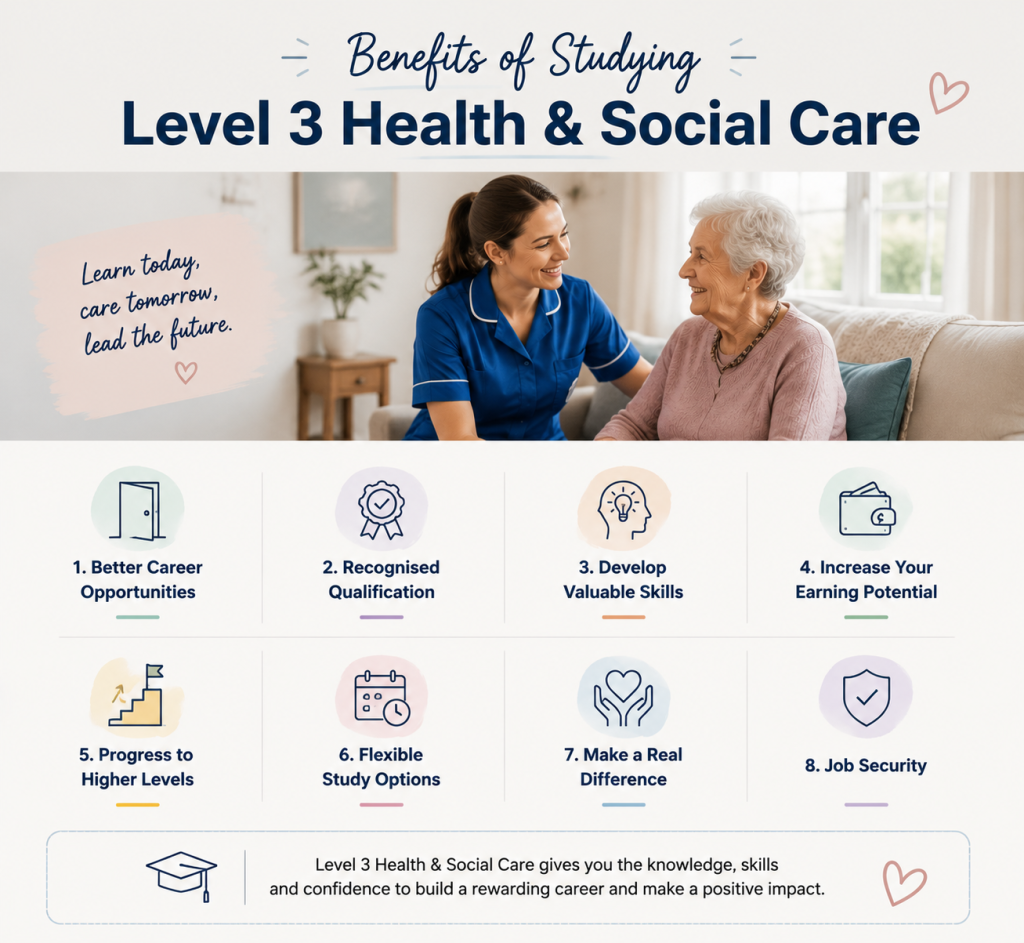
Level 3 HSC qualification offers benefits that extend beyond gaining a certificate and learners choose Level 3 because it give better future career opportunities.
Some of the main benefits include:
- A recognised qualification
- Improved job opportunities
- Practical workplace skills
- Progression to higher qualifications
- University pathways
- Better long-term career prospects
- Increased professional confidence
For many people, Level 3 becomes the foundation for a successful career within healthcare or social care.
Career Opportunities After Level 3 Health & Social Care
A Level 3 qualification can support applications for a wide range of healthcare and social care roles.
| Healthcare Roles | Social Care Roles |
| Healthcare Assistant | Care Assistant |
| Clinical Support Worker | Support Worker |
| Care Coordinator | Residential Care Worker |
| Community Healthcare Worker | Community Support Worker |
| Senior Healthcare Assistant | Family Support Worker |
Many employers recognise Level 3 as evidence that applicants have developed practical knowledge alongside professional understanding.
What Salary Can You Earn After Level 3 Health & Social Care?
Mostly in care career salaries depends on the role, employer, location, and previous experience. But after Completing a Level 3 qualification does not guarantee a specific salary, but it can improve access to better-paid roles and support career progression.
Typical salary ranges include:
| Job Role | Typical Salary |
| Care Assistant | £23,000 – £28,000 |
| Healthcare Assistant | £25,000 – £28,000 |
| Senior Care Assistant | £28,000 – £35,000+ |
| Support Worker | £24,000 – £30,000 |
| Care Coordinator | £28,000 – £35,000 |
As experience grows and additional qualifications are completed, earning potential can continue to increase and some professionals get opportunity to progress into supervisory or management positions that offer significantly higher salaries.
Get more information in this blog: Care Assistant Salary UK 2026: Average Pay, NHS Rates, Hourly Wages and Career Progression
Does Level 3 Help You Get a Better Job?
For many people, yes. Most Employers often prefer candidates who have completed recognised qualifications because they already understand key areas of professional practice.
A Level 3 qualification demonstrates that you have developed knowledge of:
- Safe care practices
- Professional responsibilities
- Communication
- Safeguarding
- Equality and diversity
- Person-centred care
Combined with practical experience, these skills can make applications more competitive and improve opportunities for career progression.
Progression to Higher Qualifications
One of the biggest advantages of studying Level 3 Health & Social Care is that it doesn’t have to be your final qualification and Many learners continue their education to develop specialist knowledge, improve career opportunities, or prepare for leadership roles.
Common progression routes include:
- Level 4 Health and Social Care qualifications
- Level 5 Leadership and Management qualifications
- Foundation Degrees
- Undergraduate degrees
- Nursing pathways
- Social Work programmes
- Public Health studies
- Healthcare Management courses
This flexibility allows learners to build their careers step by step while gaining valuable workplace experience.
For those interested in leadership roles, higher-level qualifications can prepare you to manage teams, improve care services, and take on greater professional responsibility.
Level 2 vs Level 3 Health & Social Care
Many people are unsure whether they should study Level 2 or Level 3 and the right choice depends on your current knowledge, experience, and career goals.
| Level 2 | Level 3 |
| Introduces the basics of health and social care | Develops more advanced knowledge and practical skills |
| Suitable for beginners | Suitable for learners ready to progress or build on existing knowledge |
| Focuses on everyday care responsibilities | Covers professional practice, safeguarding, leadership awareness, and person-centred care in greater depth |
| Can lead to entry-level care roles | Supports progression into senior roles, higher education, and specialist careers |
If you’re completely new to the sector, Level 2 may be the best starting point.
If you already have some knowledge, experience, or want to prepare for university or career progression, Level 3 is often the next logical step.
Is Level 3 Health & Social Care Worth It?

For many learners, the answer is yes.
A Level 3 qualification can improve confidence, strengthen job applications, and create opportunities for both employment and further study, Many employers value candidates who have completed recognised qualifications because they understand professional standards and workplace expectations.
The qualification can also help you:
- Build practical skills
- Improve career prospects
- Progress to higher qualifications
- Prepare for university
- Develop confidence in professional care settings
Others qualification guarantees employment, Level 3 provides a strong foundation for a wide range of careers in health and social care.
Where Can a Level 3 Qualification Take You?
learners begin with Level 3 and gradually progress into specialist or leadership positions.
Examples include:
Care Pathway
Care Assistant → Senior Care Assistant → Team Leader → Deputy Manager → Registered Manager
Healthcare Pathway
Healthcare Assistant → Nursing Associate → Registered Nurse
Community Support Pathway
Support Worker → Senior Support Worker → Care Coordinator → Service Manager
Each step of l usually brings greater responsibility, new skills, and increased earning potential.
Is Level 3 Health & Social Care Recognised?
Yes.
Many Level 3 Health & Social Care qualifications are regulated by Ofqual and recognised by employers across the UK.
They are designed to meet national quality standards and provide learners with knowledge that reflects current health and social care practice.
The skills developed through Level 3 are also relevant across many healthcare settings, making the qualification valuable for learners who wish to continue their careers in different parts of the sector.
For anyone planning to work outside the UK, it is important to check local employment or licensing requirements, as these vary from country to country.
Why Choose a Recognised Qualification?
Choosing a recognised qualification gives you confidence that your learning meets established quality standards.
Employers often look for qualifications that demonstrate:
- Professional knowledge
- Safe working practices
- Understanding of safeguarding
- Commitment to continuous learning
Studying a recognised programme can also improve progression opportunities into higher education and more advanced qualifications.
Who Should Consider Level 3 Health & Social Care?
This qualification may be suitable if you:
- Want to start a career in health or social care
- Already work in care and want to progress
- Plan to study nursing or social work in the future
- Want to improve your professional knowledge
- Need a recognised qualification to support career development
Whether you’re just starting out or planning your next career move, Level 3 provides a flexible pathway towards long-term professional growth.
Why Study with LCPS?
Choosing the right training provider is just as important as choosing the right qualification.
At LCPS, learners have access to recognised Health and Social Care qualifications that are designed to support both career development and further study. Whether you’re starting your first role in care or looking to progress into leadership, studying with a trusted provider can make your learning journey more rewarding.
Recognised Qualifications
Learning doesn’t stop at Level 3.
LCPS offers a range of Ofqual-regulated Health and Social Care qualifications that are recognised by employers across the UK. These qualifications are designed to meet national standards while helping learners develop practical knowledge and workplace skills.
Clear Progression Pathways
After completing a Level 3 qualification, learners can continue progressing to:
- Level 4 qualifications
- Level 5 Leadership and Management programmes
- Higher education
- Professional development courses
This creates a clear pathway from entry-level learning to senior and leadership roles.
Flexible Learning
Many learners balance study alongside work or family commitments.
Flexible learning options allow you to study at a pace that suits your schedule while continuing to receive tutor support throughout your course.
Career-Focused Learning
Every qualification is designed with employability in mind.
Learners develop practical skills, professional knowledge, and confidence that can be applied across hospitals, care homes, supported living services, community healthcare, and other health and social care settings.
Conclusion
A Level 3 Health & Social Care qualification is much more than another certificate, It provides the knowledge, practical skills, and confidence needed to build a successful career in one of the UK’s fastest-growing employment sectors.
Whether you want to become a Care Assistant, Healthcare Assistant, Support Worker, Care Coordinator, or continue your studies at university, Level 3 provides a strong foundation for future success.
It also creates opportunities to progress into senior care, specialist support, healthcare, and management roles as your experience grows.
If you’re looking for a qualification that combines practical learning with long-term career opportunities, Level 3 Health & Social Care remains one of the strongest choices available.
Frequently Asked Questions
Q1. What is Level 3 Health & Social Care equivalent to?
A Level 3 Health & Social Care qualification is generally equivalent in academic level to A Levels within the UK Regulated Qualifications Framework (RQF).
Q2. Can I study Level 3 HSC without any experience?
Yes.
Many Level 3 programmes are suitable for school leavers, adults returning to education, career changers, and individuals with little or no previous healthcare experience.
Entry requirements vary depending on the provider.
Q3. Is Level 3 Health & Social Care recognised by employers?
Yes.
Many Ofqual-regulated Level 3 qualifications are recognised by employers across the UK and are valued as evidence of professional knowledge and commitment to the sector.
Q4. What jobs can I get after completing Level 3 HSC?
Common career opportunities include:
- Care Assistant
- Healthcare Assistant
- Support Worker
- Care Coordinator
- Community Support Worker
- Residential Care Worker
- Senior Care Assistant
Many learners also continue into higher education before moving into nursing, social work, or healthcare management.
Q5. Can I go to university after completing my Level 3 Health & Social Care?
Yes.
Many learners use Level 3 as a pathway into university courses such as:
- Nursing
- Social Work
- Public Health
- Healthcare Management
- Occupational Therapy
- Allied Health Professions
University entry requirements vary, so always check individual course criteria.
Q6. Is Level 3 Health & Social Care difficult?
The course is more advanced than Level 2, but it is designed to build knowledge gradually.
With regular study, tutor support, and commitment, many learners successfully complete the qualification.
Q7. Can adults study Level 3 Health & Social Care?
Yes.
Level 3 is suitable for learners of all ages, including adults returning to education or changing careers.
Many providers also offer flexible online learning options.
Q8. How long does a Level 3 Health & Social Care course take?
Most learners complete the qualification within 6 to 18 months, depending on whether they study full-time, part-time, or through flexible online learning.
Q9. Is Level 3 Health & Social Care worth it?
For many learners, yes.
The qualification helps improve employability, supports career progression, prepares learners for higher education, and develops practical skills that employers value across the health and social care sector.