Overview
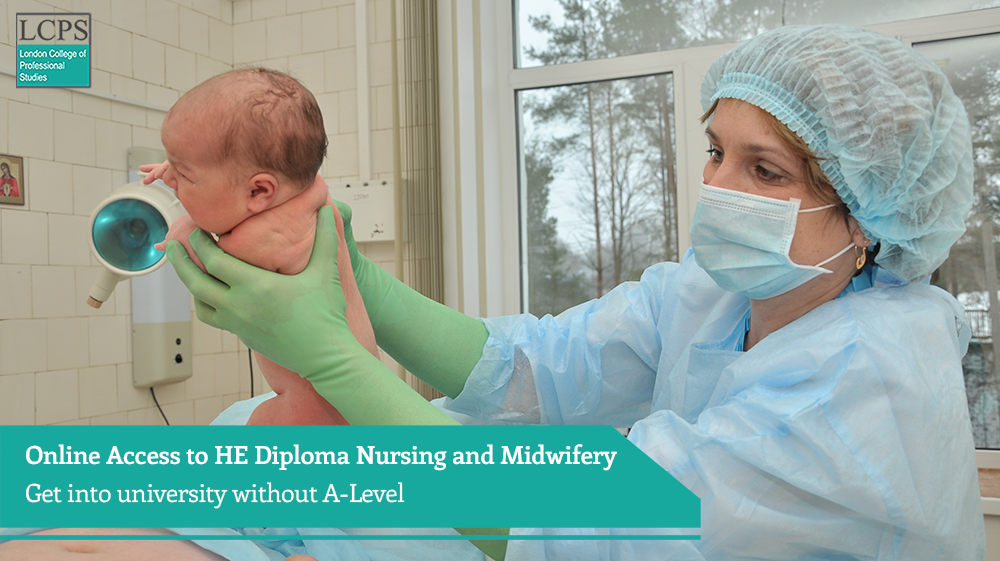
The Access to Higher Education (HE) Diploma in Nursing and Midwifery is a nationally recognised Level 3 qualification designed as a gateway to university study for adults who wish to pursue a career in nursing or midwifery.
This course prepares learners with the academic knowledge, study skills and confidence required to progress to a BSc (Hons) Nursing or Midwifery degree at university in the UK.
What does this course cover?
- Principles of Nursing Practice
- Maternity and Child Health
- Safeguarding in Healthcare
- Infection Prevention and Control
- Ethical and Legal Issues in Healthcare
Does it give me UCAS Tariff Points?
Yes. An Access to HE Diploma carries up to 144 UCAS tariff points depending upon grades achieved.
The Diploma is made up of 45 graded credits and 15 ungraded credits. 144 points equates to 45 Distinctions in the Diploma. At A level, 144 points equals 3 grade A’s. You can calculate UCAS Tariff Points for different Grades using the Tariff Calculator
Delivery Methods
To cater to different learning styles and preferences, the London College of Professional Studies (LCPS) offers a range of flexible delivery methods, allowing learners to study in a way that suits their needs and schedules.
Learners will be able to:
- Access all course materials – including online modules, study guides, and written assignments.
- Receive expert tutor support throughout the course.
- Use the LCPS Online Learning Portal – available 24/7, providing a user-friendly platform for all study resources.
- Obtain detailed assignment briefings to guide assessment preparation.
- Access high-quality study notes designed to support learning and understanding.
- Receive assignment feedback and marks to monitor progress and improvement.
- Earn a fully accredited UK qualification upon successful completion.
- Get dedicated customer support via chat, telephone, or email (Monday to Friday).
- Enjoy full academic and administrative support from enrolment to course completion.
Course Delivery
Duration
Access to Higher Education Diploma (Nursing and Midwifery) is available in 2 durations:
Learners are granted a maximum of 18 months access to complete the course from the date of enrolment.
Accreditation
Access to Higher Education Diploma (Nursing and Midwifery) programme is accredited by Gateway Qualifications awarding body regulated and licensed by the QAA for Access Courses
 Successful candidates will be awarded a nationally recognised Access to HE Diploma awarded by Gateway Qualifications. The diploma is approved by the Quality Assurance Agency for Higher Education (QAA) and is accepted for entry to a wide range of universities and higher education institutions.
Entry Requirements
To study Access to Higher Education (HE) Diploma in Nursing and Midwifery course Learners should be aware that entry requirements vary for nursing and midwifery courses, but as a minimum, you should have the following:
- GCSE grade C/4 or above in Maths and English (or Functional Skills equivalent) or Level 2. If you do not have these already, you can study these with us.
- Level 2 Functional Skills in English and Maths or GCSE equivalent international qualifications. You may need functional skills qualifications
- Learners must be age of 19 to study the qualification
Module Structure
Learners must achieve a total of 60 credits, of which 45 credits must be achieved at level 3 from graded units which are concerned with academic subject content and the remaining 15 credits must be achieved at level 3 from units which are ungraded.
- All learners must register for at least one 6-credit or one 9-credit unit as part of their programme of study; this can be a graded or ungraded unit.
- The maximum number of credits that can be made up from 6-credit or 9-credit units is 30 credits; this can be from graded and ungraded 6-credit and 9-credit units.
Access to HE Diploma (Nursing and Midwifery) Units Break down
Mandatory Graded
| Unit Title |
Level |
Credit |
| Homeostasis |
3 |
3 |
| Human Anatomy and Physiology |
3 |
6 |
| Human Reproduction and Health Related Issues |
3 |
3 |
| Introduction to Biology: Cells and Tissues |
3 |
3 |
Optional Units: Graded
Research Graded Academic Subject Content
| Unit Title |
Level |
Credit |
| Research Skills for Health or Care |
3 |
6 |
| Antenatal Care and the Role of the Midwife |
3 |
3 |
Graded Health Context
| Unit Title |
Level |
Credit |
| Understanding Perinatal Mental Health |
3 |
3 |
| Health Inequalities |
3 |
3 |
Graded Sociology
| Unit Title |
Level |
Credit |
| Introduction to Sociology |
3 |
3 |
| Developmental Psychology |
3 |
3 |
| Introduction to Psychology |
3 |
3 |
Graded Phycology
| Unit Title |
Level |
Credit |
| Health Psychology |
3 |
6 |
Mandatory Ungraded
| Unit Title |
Level |
Credit |
| Professional Behaviours: Nursing and Health Professions |
3 |
3 |
Numeracy in a Health Context Ungraded
| Unit Title |
Level |
Credit |
| Numeracy in a Health Context |
2 |
3 |
Optional Units: Ungraded
| Unit Title |
Level |
Credit |
| Academic Writing Skills |
3 |
3 |
| Study Skills for Higher Education |
3 |
3 |
| Communication – Speaking and Listening |
3 |
3 |
Who is it suitable for?
The Access to HE Diploma (Nursing and Midwifery) is suitable for adults who want to progress to university and pursue a career in nursing, midwifery, or healthcare. It is particularly beneficial for:
- Individuals who do not have A-Levels or traditional university entry qualifications.
- Adult learners returning to education after a break.
- Healthcare assistants, support workers, and carers seeking career progression.
- Individuals looking to change careers and enter the healthcare sector.
- Those aspiring to study Adult Nursing, Children’s Nursing, Mental Health Nursing, Learning Disability Nursing, Midwifery, or related healthcare degrees.
- Learners who require a recognised Level 3 qualification to meet university entry requirements.
What could this qualification lead to?
An Access to HE Diploma in Nursing & Midwifery provides individuals with the necessary knowledge and skills to progress to a degree program in nursing or midwifery. Successful completion of this diploma can lead to several potential outcomes:
- Higher education:
- Many students who complete an Access to HE Diploma in Nursing & Midwifery use it as a stepping stone to pursue a related degree program, such as a Bachelor of Science (BSc) in Nursing or a Bachelor of Midwifery.
- Professional qualifications:
- Graduates of a nursing or midwifery degree program can become registered nurses or midwives, respectively, after completing the necessary licensing examinations. This can lead to a career in various healthcare settings, such as hospitals, clinics, community health centers, or private practices.
- Specialisations:
- After gaining experience in the field, individuals may choose to specialize in areas such as paediatrics, geriatrics, mental health, or obstetrics, among others, depending on their interests and career goals.
- Further education:
- Some graduates may choose to pursue advanced degrees, such as a Master of Science in Nursing or a Doctor of Nursing Practice, to advance their careers and take on leadership roles in healthcare organizations, education, or research.
- Research and academia:
- Those with a passion for research and teaching may explore opportunities in academic institutions, conducting research, publishing papers, and educating the next generation of nursing or midwifery professionals.
Overall, an Access to HE Diploma in Nursing & Midwifery provides a solid foundation for individuals to enter the field of nursing or midwifery and offers a range of opportunities for professional growth and development within the healthcare sector.
Progression
- After completing an Access to HE Diploma (Nursing and Midwifery) learner will progress
- You can progress to health-related higher education programmes at university the 3 years B.Sc including nursing, midwifery and the allied health professions such as occupational therapy.
- Learners can go into many different nursing roles which include adult nurse and health & social care profession etc.
Assessment
The qualification will be assessed using a range of methods. This could include
- Presentation,
- One to one discussion with teacher or a portfolio of evidence,
- Written assignments,
- or a Task.